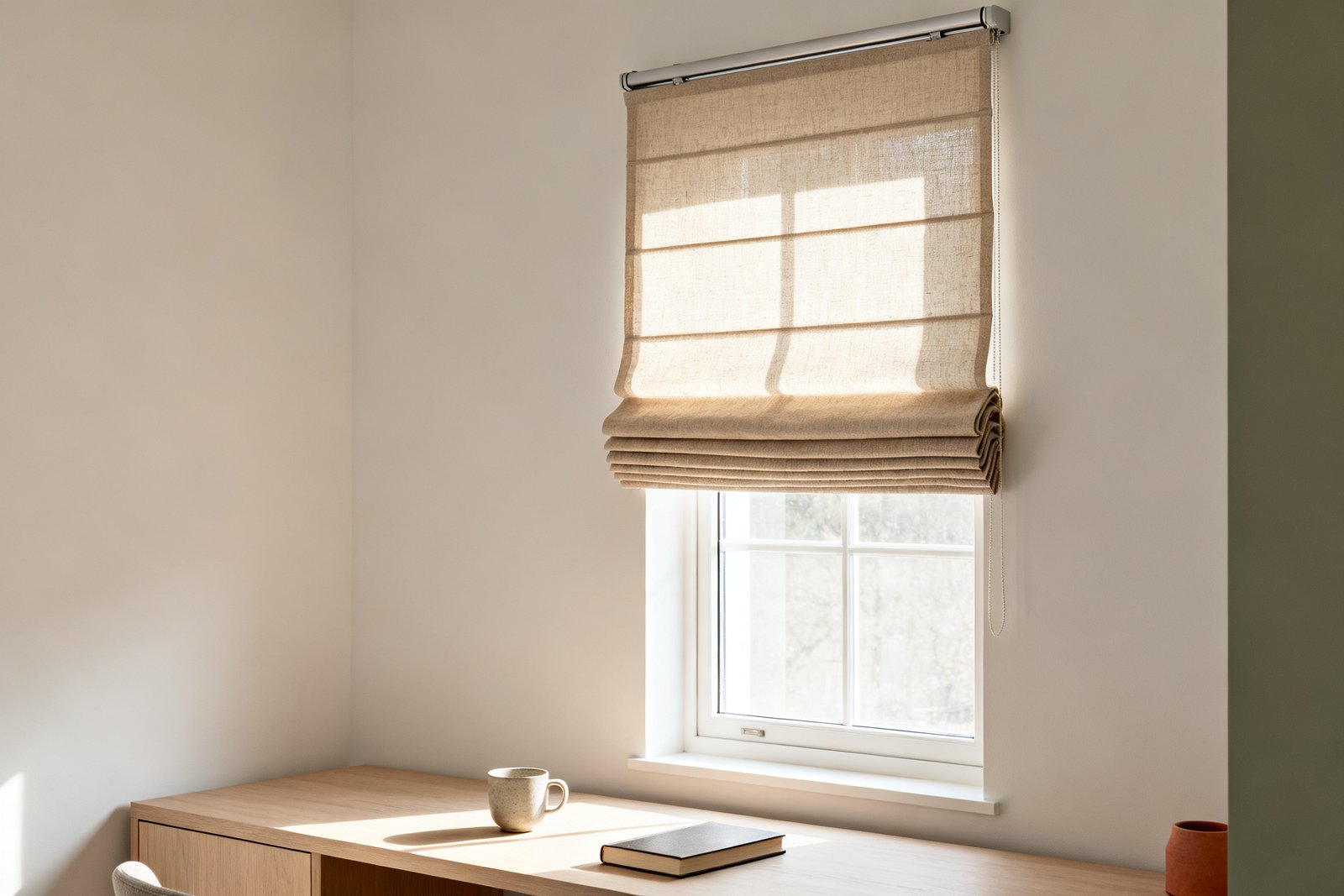
In the room

Listed at $109.99. listed price (9 colourways, all at 109.99, no compare_at). Made-to-measure shade: size, lift, motorisation and Lining Type are billed through the conf
Catalogue photo from Two Pages, retrieved 2026-08-22.
A roman shade is sold to you as a fabric and delivered to you as a mechanism. Everything on the listing is cloth (the name, the photograph, the colourway, usually the price) and everything that decides how the thing behaves on your wall is the rail above it and the way the panel is built to gather.
It is worth being concrete about what that means, because the mechanism is not a hidden internal: it is most of what you look at. The rail is a box across the top of your window, and the stack of folded cloth that gathers under it is on show all day, whether the shade is up or down. The cloth you chose is the part that disappears when the shade is raised.
That gap is the reason these catalogues feel unreadable. But the catalogue is not hiding it. Across eleven listings from three merchants, read on their own product pages in August 2026, the shape of each catalogue turns out to be the most reliable information on it: one merchant spends eleven separate product pages on a single cloth, another spends a hundred and forty-three on colour. That is not noise, and it is not merchandising clutter. It tells you which variant each merchant is actually set up to build, and it decides which number you end up anchored to.
What the shape of a catalogue tells you before you read a price
Checked on 22 August 2026, on each merchant’s own roman shade collection: 112 listings at Two Pages, 106 at Neutral Curtains, 143 at Half Price Drapes. Three totals in the same range, describing three completely different businesses.
Two of the three cut their range by fabric, then by fold, then by function. That is why one Neutral cloth (Lily, at 350 gsm) occupies eleven product pages and six floor prices, from $35.99 to $119.99, with plain fold, relaxed, flat fold, top-down-bottom-up, a blackout version, a French door version and two- and three-shade headrails each holding their own page.
One fabric, one merchant: what the fold style costs
Two Pages · Patti Linen Deco Fold Roman Shade Cordless
100% Belgian Linen · 248 gsm, 6 separate listings, 3 different floor prices
Neutral Curtains · Lily Linen Roman Shades & Blinds
80% polyester, 20% linen · 350 gsm, 11 separate listings, 6 different floor prices
Each row is its own product page at that merchant, carrying the same fabric. The lowest bar is the figure you meet first. Prices are floor prices before size, lining and lift are chosen, so they are starting points, not what a finished shade costs. 17 listings read on the merchants’ own collection pages.
Source: official product pages from Half Price Drapes, Neutral Curtains, Two Pages, checked 2026-08-21 and 2026-08-22. Fold & Light does not measure products; any percentage is the one that brand publishes.
The third does the opposite: all 143 Half Price Drapes listings carry a single variant each, across seven fabric families. One page per colour.
Read those two structures as statements of capability and they stop being confusing. A merchant that spends eleven pages on one cloth is tooled to build that cloth many ways: you can reasonably expect to get the mechanism you want in the fabric you want, and the fabric you want in the mechanism you want. A merchant that spends its pages on colour is tooled to sell colour, and offers you a two-option dropdown for the mechanism, but every colourway you are choosing between has been photographed as a finished product rather than named on a swatch card. Neither is the better catalogue. They are answers to different questions, and knowing which question a merchant has answered saves you from asking it the wrong one. The same reading works one level up, where the shade and blind families divide up by what moves rather than by what they are called.
The colour-led model carries one specific risk, and it is the most expensive mistake available on a made-to-measure order.
Easy to get wrong
| The habit | What it costs | Instead |
|---|---|---|
| Choosing the colour on a screen The colourway is picked from a product photograph on a lit display. | The panel arrives reading warmer, colder or flatter than expected, and on a made-to-measure order it cannot be returned. | Order a swatch, or a single panel, and look at it in the room at midday and at night before committing to the rest. |
Common failure modes and their fix. No product data on this card.
The floor price belongs to a listing, not to a product
Here is what that architecture costs you if you read it front to back. Across these eleven listings there are ten different pricing bases, and in a catalogue cut into variants, the number displayed first is always the cheapest variant, which is almost never the one you came for.
What each price actually covers
| Brand | Listed | Basis |
|---|---|---|
| Two Pages Patti Linen Deco Fold Roman Shade Cordless | $109.99 | listed price (9 colourways, all at 109.99, no compare_at). Made-to-measure shade: size, lift, motorisation and Lining Type are billed through the configurator. |
| Two Pages Liz Linen Roman Shade Cordless | $59.99 | listed floor price, identical on all 38 colourways, no compare_at. Made-to-measure: size, lift, lining and motorisation are billed through the configurator. |
| Two Pages Jawara Linen Cotton Roman Shade Cordless | $119.99 | listed floor price, identical on all 23 colourways, no compare_at. Made-to-measure: size, lift, lining and motorisation are billed through the configurator. |
| Two Pages Isabella Roman Shade Cordless | $79.99 | lowest of two floor prices carried by the same listing (79.99 and 119.99 across 36 colourways). Made-to-measure: size, lift, lining and motorisation are billed through the configurator. |
| Two Pages Smart Motorized Plain Roman Shade Cordless | $49.99 | starting price of the cheapest of nine fabric collections (Kyla 49.99, Liz 59.99, Cloe and Sara Le 69.99, Jawara, Patti, Isabella and Ron 79.99, Holly 119.00), no compare_at. Size, power type and remote are entered in the configurator. |
| Neutral Curtains Lily Linen Roman Shades & Blinds | Plain Fold | $35.99 | base price of the PLAIN FOLD only, add-ons excluded |
| Neutral Curtains 100% Belgian Flax Linen Roman Shades & Blinds | $99.99 | base price, add-ons excluded ('Total Price = Base Price + Add-ons'). Made to measure. |
| Neutral Curtains Custom Motorized Roman Shade & Blinds | $39.99 | lowest of ten fabric collections (Lily 39.99, Kelly 49.99, Liz and Vivienne 69.99, Jenna, Bella and Cove 74.99, Loxley 85.99, Belgian and Meadow 99.99). The page states the rule itself: Total Price = Base Price + Add-ons, and motorisation is one of those add-ons. |
| Half Price Drapes Crisp White French Linen Roman Shade | $179.20 | figure shown before the size calculation; the page carries a Price Calculator (Regular Price / Final Price) that recomputes on width x length. Sold per shade. |
| Half Price Drapes Light Ochre Solid Cotton Blackout Tie-Up Window Shade | $10.50 | price of the single ready-made size, 46W x 63L. Sold per shade, nothing to configure. |
| Half Price Drapes Millstone Grey Solid Cotton Room Darkening Tie-Up Window Shade | $10.50 | price of the single ready-made size, 46W x 63L. Sold per shade, nothing to configure. |
Not like-for-like. These figures rest on different bases, so they cannot be ranked against each other. Read what each price covers before comparing.
Source: official product pages from Half Price Drapes, Neutral Curtains, Two Pages, checked 2026-08-21 and 2026-08-22. Fold & Light does not measure products; any percentage is the one that brand publishes.
Three listings show the mechanism plainly. On the Isabella at Two Pages, one product page carries two floor prices, $79.99 and $119.99, depending which of its 36 colourways you land on. On the motorised roman shade at the same merchant, the headline $49.99 is the Kyla collection; pick the Holly on the same page and the floor is $119.00. And the $35.99 that opens the Neutral range is the plain fold, the cheapest of the eleven Lily pages.
None of this is concealed, and none of it is a trap in the ordinary sense. It is simply that a floor price answers the question “what is the least this merchant will take from anyone” and you are asking “what will this cost me”. That gap is the normal condition of made-to-measure, and it is worth reading once in full: what a made-to-measure floor price leaves out. The fix is a habit rather than a calculation: decide the mechanism you want first, find the listing that carries it, and read that listing’s floor. Read the range’s floor and you will calibrate your whole budget against a variant you have already ruled out.
In the room

Listed at $79.99. lowest of two floor prices carried by the same listing (79.99 and 119.99 across 36 colourways). Made-to-measure: size, lift, lining and motorisation a
Catalogue photo from Two Pages, retrieved 2026-08-22.
The cost of getting that wrong is not only financial, and it shows up on wide windows. A single roman shade taken to the top of its width range gathers all of that cloth into one band, so the stack grows deeper and the horizontal folds sit further apart as the panel widens. The proportion that looked tailored on a sample reads heavy once it is four feet across. The answer is in the same catalogue, filed where a floor-price shopper never looks: two shades on one headrail at $79.99, three at $119.99, in the identical cloth whose plain fold opens at $35.99. Split across a bay, each panel keeps a shallow stack and a fine fold, and the window keeps its rhythm. Budget from the range floor and that option is three times your number; budget from the variant you want and it was always the point.
Sold as cloth, delivered as a rail
Under the eleven listings there are only a handful of things that actually move, and the listing names almost never say which one you are getting.
Most of them are a panel that folds upward onto a headrail: cordless on some pages, a continuous cord loop on others, a motor on a few. Two of the eleven move in both directions, top and bottom. And two of them do not move at all: a tie-up shade has no lift mechanism whatsoever. A four-inch pole pocket slides onto a rod of up to 1 1/2 inches, and two fabric ties seventy inches long gather the panel by hand. The brand is straightforward about it, describing a stationary style not designed for daily raising and lowering. It is a curtain that has been folded up and pinned, sold in one ready-made size of 46 by 63 inches, which is why it is $10.50 while the made-to-measure shades on the same page start thirty dollars higher.
In the room

Listed at $10.50. price of the single ready-made size, 46W x 63L. Sold per shade, nothing to configure.
Catalogue photo from Half Price Drapes, retrieved 2026-08-22.
The rail matters more than the mechanism’s name, because the rail is the part that stands between your glass and your room. Motorising a shade at Two Pages moves it onto an aluminium headrail of 2 3/4 by 2 inches needing 4 inches of window depth, where the same merchant’s manual shades want 2 1/2. That is not a specification difference; it is the difference between a shade that sits inside your window and one that does not fit there at all.
One more thing arrives with the mechanism whether you asked for it or not: at Two Pages, shades under 34 inches long ship with three folds by default. On a short window three folds is a coarse stack: the panel is divided into deep sections rather than fine ones, and the horizontal lines land far apart on a small pane. It is a manufacturing default, not a design choice, and it is changed by writing to the merchant rather than by clicking anything.
A raised shade still covers your window, and one listing says how much
The most consequential number in this entire category is published by exactly one of the eleven listings, and it has nothing to do with price.
Neutral Curtains states a stack height of approximately 7 to 10 inches when the shade is fully raised, adding that the figure varies with style and size. The other ten say nothing, and we are not estimating for them. Here is why it decides more than the fabric does: a roman shade does not retract, it accumulates. Pull it all the way up and a band of folded cloth sits across the top of the opening and stays there all day. On a 36-inch window, ten inches of stack is more than a quarter of the glass, so the shade you bought to control light is removing light at the exact moment you want it, and the window reads shorter than it is even when the shade is “open”.
Rule of thumb
7–10 in of stack
The window a raised shade still covers
Allow seven to ten inches of stacked fabric at the top, and mount above the frame to get it back.
A roman or woven shade folds upward into a band that does not disappear. Inside the reveal, that band sits on your glass all day. Mounted above the frame it sits on the wall instead, and the window keeps its full height when the shade is up.
2–4 in overlap per side
Inside or outside the reveal
Inside keeps the frame visible and leaks light at the sides. Outside covers the frame, needs two to four inches of overlap per side, and reads larger.
This is a proportion decision disguised as a fitting decision. An inside mount keeps a handsome frame on show and accepts a strip of daylight down each edge. An outside mount gives a clean rectangle that makes a small or awkward window look bigger, and it is the only one of the two that gets close to a dark room.
Geometry and long-standing trade practice, not a brand claim. Check it with a tape measure, not with us.
That is also the answer, and it is free: the stack has to exist, but it does not have to sit on the glass. Mounted above the frame it lands on the wall instead, and the window keeps its full height whenever the shade is up. This is the single decision on this page that costs nothing and changes the room, which is why it is worth making before any of the ones that cost money.
In the room

Listed at $35.99. base price of the PLAIN FOLD only, add-ons excluded
Catalogue photo from Neutral Curtains, retrieved 2026-08-22.
Two smaller figures come from the same habit of reading past the photograph. Neutral publishes a manufacturing tolerance of approximately 0.4 inches on the finished shade, declared variance, not a defect, and a reason to think twice about an inside mount in a reveal you measured to the millimetre. And on the same page it gives its size envelope in eighths of an inch, from 22 to 98 wide and 14 to 119 long, which is a wider range than most rooms will ever need and a useful signal about what the merchant is set up to make.

Where this figure comes from
Neutral Curtains · 100% Belgian Flax Linen Roman Shades & Blinds
Listed from $99.99
What that covers: base price, add-ons excluded ('Total Price = Base Price + Add-ons'). Made to measure.
Build your size at Neutral CurtainsAffiliate link, disclosed: Fold & Light may earn on it, never as a surcharge to you, and it changes nothing about what Neutral Curtains asks. The figure is dated 2026-08-21 and only the merchant page is current. The image above comes from the Neutral Curtains listing, retrieved 2026-08-22.
Darkness is a lining, and every catalogue files it somewhere different
Nine of these eleven listings publish no opacity percentage at all, and the two that do are the tie-up shades. On this product that silence is honest rather than evasive, because on a roman shade the darkness is not a property of the cloth you are looking at. It is a separate layer, chosen after the fabric, and each merchant has put that choice in a different part of its catalogue.
One names three linings on the product page (Privacy, Lined & Interlined, Blackout) and states outright that opacity depends on which you take. Another calls it a configurator step, Lining Type. The third calls it Shading Rate.
Fold styles

Catalogue photo from Half Price Drapes, retrieved 2026-08-22.
The clearest statement of the principle comes from a listing that ought not to need it: on the day-night version of its Patti linen, Two Pages writes that you must opt for a blackout liner to get a true blackout on the night layer. A product built in two layers, one of them named for darkness, still sells the darkness separately.
A lining is not only a light decision, though, and this is the part no listing mentions. Every fold on a roman shade is the panel doubled back on itself, so adding a lining adds a layer at every one of those folds. The stack gets thicker and taller, and a shade specified at the top of its width range with a heavy interlining will sit deeper off the wall than the same shade unlined. If your reveal is tight, the lining is a fitting decision wearing a lighting costume.
Worth doing
Find the leak before you upgrade the fabric
Stand in the room at midday with the curtain shut and look at where the light actually is: top, sides, or through the cloth.
Most rooms that fail a blackout test are leaking around the panel, not through it. If the light is at the edges, a heavier fabric grade changes nothing. A ceiling fixing, a wider rod or a wraparound track does.
A practical step, not a product claim. Nothing here depends on which brand you buy.
None of these percentages are ours. We do not measure products, and the vocabulary here is regulated by nobody, which is the whole subject of the opacity ladder, and who publishes what.

Where this figure comes from
Half Price Drapes · Crisp White French Linen Roman Shade
Listed from $179.20
What that covers: figure shown before the size calculation; the page carries a Price Calculator (Regular Price / Final Price) that recomputes on width x length. Sold per shade.
Build your size at Half Price DrapesAffiliate link, disclosed: Fold & Light may earn on it, never as a surcharge to you, and it changes nothing about what Half Price Drapes asks. The figure is dated 2026-08-22 and only the merchant page is current. The photo is a catalogue shot from Half Price Drapes, retrieved 2026-08-22.
What the floor price leaves out, priced by the one merchant who prints it
Motorisation is where the gap between the advertised number and the real one is widest, and exactly one of the three merchants will tell you the size of it.
At Neutral Curtains the configurator prices the motor at $118.00, a one-channel remote at $19.90, and the wifi hub power supply at $15.99, and the page totals its own default selections at $153.89, against a listed floor of $39.99. The remote is described as optional and, in the same sentence, as required at least once to pair the shade. So the real opening figure for a motorised shade there is close to four times the number that drew you onto the page.
In the room

Listed at $49.99. starting price of the cheapest of nine fabric collections (Kyla 49.99, Liz 59.99, Cloe and Sara Le 69.99, Jawara, Patti, Isabella and Ron 79.99, Holly
Catalogue photo from Two Pages, retrieved 2026-08-22.
The comparison the other two allow is narrower and still says something. On its own motorised listing, Two Pages publishes ten fabric compositions with ten gram weights (Liz at 350, Jawara at 274, Patti at 248, Isabella at 500, Ron at 205, Kyla at 220, Cloe at 290, Sara Le at 350, Ian at 305, Holly between 280 and 330) along with four smart-home ecosystems, and no motor surcharge, no battery life and no noise level. The cloth is documented to the gram; the thing you are actually buying is not. Half Price Drapes sidesteps the question entirely: checked on 22 August 2026 it lists no motorised shade at all, its roman shades running on a plastic beaded continuous loop.
Minimum window depth for an inside mount
Two Pages
4 in
Smart Motorized Plain Roman Shade Cordless
Half Price Drapes
2 3/4 in
Crisp White French Linen Roman Shade
Two Pages
2 1/2 in
Liz Linen Roman Shade Cordless
Two Pages
2 1/2 in
Jawara Linen Cotton Roman Shade Cordless
Neutral Curtains
2 1/2 in
100% Belgian Flax Linen Roman Shades & Blinds
Neutral Curtains
2 1/2 in
Custom Motorized Roman Shade & Blinds
Two Pages
2 3/8 in
Patti Linen Deco Fold Roman Shade Cordless
Measure the reveal before choosing a fabric. A shallow frame rules options out faster than a budget does.
Source: official product pages from Half Price Drapes, Neutral Curtains, Two Pages, checked 2026-08-21 and 2026-08-22. Fold & Light does not measure products; any percentage is the one that brand publishes.
There is a mounting consequence hiding in the price difference, and it is the one to check first. A motor needs a bigger box: 4 inches of depth at one merchant against 2 1/2 recommended at another, for the same job. A motor also removes something you can see: with no continuous loop there is no beaded cord hanging down one edge, which on a narrow window is the difference between a clean vertical line and a dangling one at eye level. A rail that will not fit inside the reveal has to go on the wall above it, and there it sits proud of the frame: what you see from the sofa is a box on the wall with a shade under it, not a shade set into a window. Decide whether your reveal can take the rail before you decide whether your budget can take the motor. The rest of the accounting is in what motorisation adds to a shade, and what it does not.
Reading a catalogue of three hundred shades
Everything above collapses into a short reading order, and it works on any of the three catalogues because it starts from the thing the catalogue is organised around rather than the thing it advertises.
Start from the mechanism, not the fabric and not the price. Decide whether you need one that goes up, one that opens from the top, or one that never moves. That single choice eliminates most of a 143-page range before you have looked at a colour.
Find where that merchant filed it. A separate product page, a word inside the product name, or a dropdown: the structure you read in the first section tells you which to expect, and knowing that is the difference between a five-minute search and an hour of scrolling.
Rule of thumb
Measure every window, even the identical ones
Two windows on the same wall are rarely the same size. Measure width in three places, height in three places, and use the smallest.
Frames settle, plaster is not square, and a made-to-measure order is cut to the number you send. The three-point measurement is not caution, it is the only way to find the number that will actually fit.
Geometry and long-standing trade practice, not a brand claim. Check it with a tape measure, not with us.
Read the floor attached to your variant. Not the range’s floor, not the collection’s. If the page carries several, as the Isabella does, find the one attached to your colourway.
Measure the reveal against the rail you have chosen, not the shallowest number on the page, and then decide inside or outside mount deliberately rather than by default, because that is where the stack goes. Inside, the frame stays visible and the folds sit on your glass; outside, the frame disappears under a clean rectangle that reads larger than the window it covers. Both are defensible. Only one of them is chosen on purpose, and it starts from a number you took yourself: measure the reveal before you order anything.
Only then is there anything to compare, and comparing is a different job with different rules: three linen roman shades, compared takes three products through it.
One last thing worth knowing before you commit a catalogue to a room, because it dissolves the hardest trade-off on this page, the one between a shade that darkens well and a window that looks like something.
Another way to do it
A shade for the light, panels for the room
Fit a plain shade inside the reveal for light control, and hang decorative panels outside the frame that never actually close.
It separates the two jobs a window treatment is asked to do, and each one gets to be good at its own. The shade does the darkness and can be cheap and plain; the panels do the proportion and the softness and can be the fabric you actually wanted. It is also how you get a dark room without buying dark curtains.
An arrangement, not a recommendation to buy anything. It works with whatever you already own.
Where this figure comes from
Two Pages · Patti Linen Deco Fold Roman Shade Cordless
Listed from $109.99
What that covers: listed price (9 colourways, all at 109.99, no compare_at). Made-to-measure shade: size, lift, motorisation and Lining Type are billed through the configurator.
Build your size at Two PagesAffiliate link, disclosed: Fold & Light may earn on it, never as a surcharge to you, and it changes nothing about what Two Pages asks. The figure is dated 2026-08-22 and only the merchant page is current. Catalogue photography supplied by Two Pages, retrieved 2026-08-22.
Common questions
Why does one fabric appear on eleven different product pages?
Because two of these three merchants cut their catalogue by fabric, then by fold, then by function, and each combination gets its own page with its own base price. Checked on 22 August 2026, the Lily cloth at Neutral Curtains occupies eleven listings at six floor prices, from $35.99 to $119.99. Read as a signal rather than as clutter, that structure tells you the merchant is set up to build that cloth many ways, which is useful, as long as you go to the page carrying your variant instead of the one carrying the lowest number.
Which price on a roman shade listing is the real one?
None of the eleven floors is the price of a finished shade; they rest on ten different bases. Some are configurator floors before size, lining and lift are chosen; one is a base price the merchant explicitly defines as base plus add-ons; one is recalculated by a price calculator once you enter your width and length; and two are firm prices for a single stock size. They cannot be ranked against each other. The only comparison that exists on made-to-measure is the total each configurator returns at your real measurements.
How much of my window will the shade still cover when it is up?
One listing of the eleven publishes it: approximately 7 to 10 inches of stacked fabric when fully raised, and the merchant notes it varies with style and size. The other ten are silent, and we do not estimate for them. On a short window that band is a significant share of the glass, and it sits there all day. Mounting above the frame rather than inside the reveal puts the stack on the wall instead, which costs nothing and gives the height back.
Does motorising a roman shade change anything except the price?
Yes, and the mounting change is the one that can stop the order. A motor rides on a larger headrail: Two Pages requires 4 inches of window depth for its motorised roman shade against 2 1/2 for its manual ones, and Neutral Curtains recommends 2 1/2 for its own motorised system. On the money, one merchant publishes the figures: $118.00 for the motor, $19.90 for the remote, $15.99 for the hub power supply, which its own page totals at $153.89 against a $39.99 floor. Two Pages publishes no motor surcharge, no battery life and no noise level, and Half Price Drapes lists no motorised shade.
Why do so few listings publish an opacity figure?
Because on a roman shade the darkness is a lining rather than a fabric, so the number would belong to a layer you have not chosen yet. Nine of these eleven listings publish no percentage; the two that do are tie-up shades, whose brand states the privacy lining blocks approximately 60-65% of incoming light. That is a manufacturer claim, quoted as published. We do not measure products. Choose the fabric for how it looks and the lining for how dark you need the room, and expect the lining to be priced separately.
Is a tie-up shade a roman shade?
No, and the brand says so on the page. A tie-up shade has no lift mechanism: a four-inch pole pocket slides onto a rod of up to 1 1/2 inches in diameter, and two seventy-inch fabric ties gather it by hand. The listing describes a stationary style not designed for frequent daily raising and lowering, and sells it in one ready-made size of 46 by 63 inches. It is a decorative panel that happens to be filed beside the shades, useful on a window you never operate, and the wrong object everywhere else.