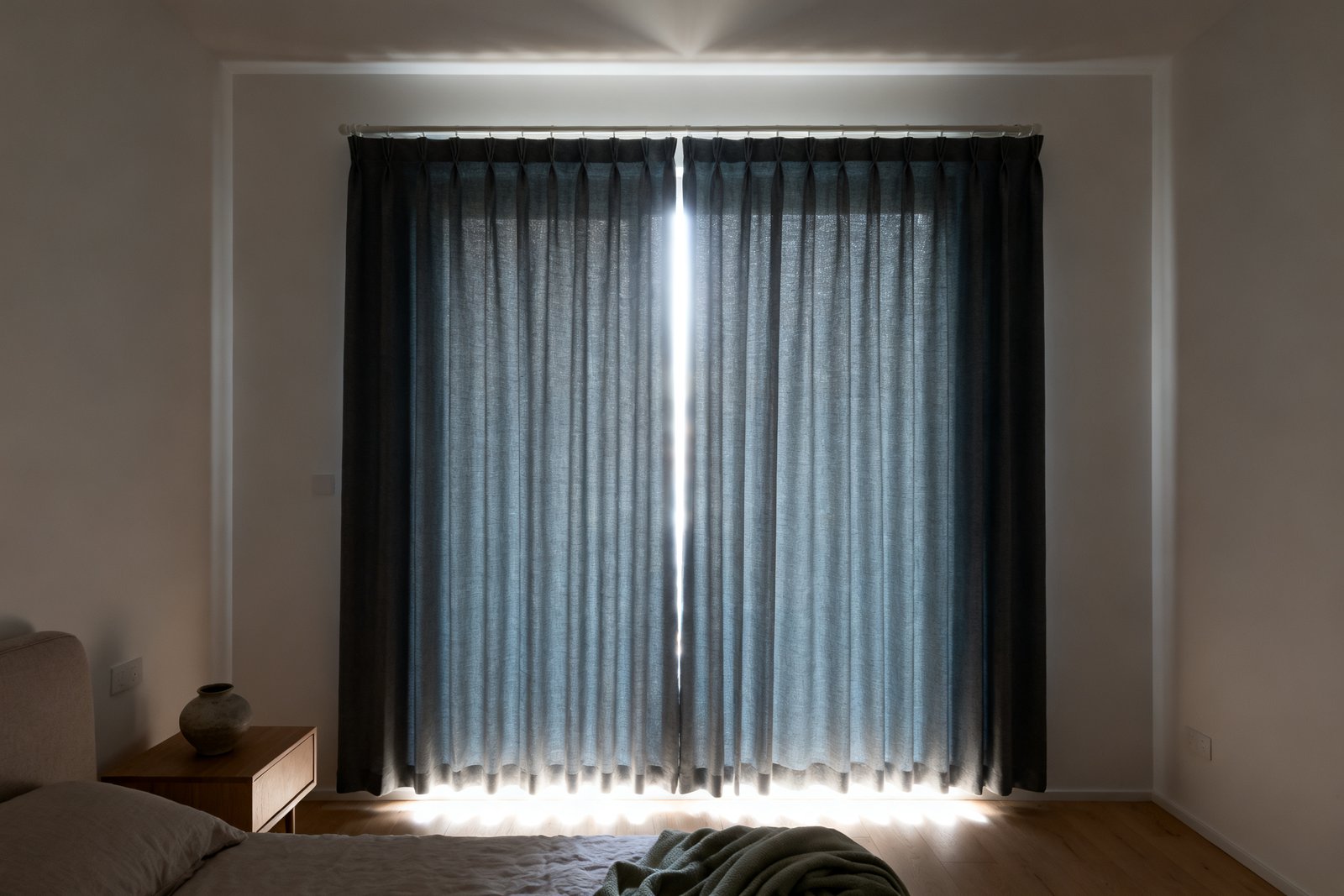
Two Pages sells one curtain, the Liz linen pinch pleat, in two versions. One is listed with a room darkening lining. The other is listed with a blackout thermal lining. The face fabric is the same heavyweight linen blend, 350 gsm, on both, and the curtain you see from inside the room is the same panel. Only the lining behind it changes, and with it the word on the label.
That is the whole problem with the opacity ladder in one product. Blackout, room darkening and light filtering read like three measured steps down from full daylight to full dark, and most people choosing window shades or curtains expect each word to mark a fixed amount of light. They are not measured, and they are not always steps. They are names, and on the listings that use them the name tells you less than one plain question does: where does the darkness actually come from. This page answers that question family by family, so the next time a label promises you a dark room you know what to look for behind it.
The same curtain, sold as two levels of dark
Start with the Liz pinch pleat, because it removes the fabric from the argument entirely. Both versions carry the same 350 gsm face, so nothing about the linen you can see or touch separates a room darkening panel from a blackout one here. The difference is a lining sewn behind the fabric, and it is chosen and paid for as an add-on. What changes the room at six in the morning is that lining, not the linen.
Neutral Curtains prices the same idea in the open. Its 100% Belgian linen pleated panel is a 250 gsm fabric listed at 89.99 dollars, and at that base price the brand describes it as non blackout: the blackout is a lining you add in the configurator, not something the panel arrives with. So on both brands the level of dark is an assembly decision made behind the face fabric, and it is a line on the order, not a property of the cloth you fell for.
In the room

This listing does not publish the figure.
Catalogue photo from Two Pages, retrieved 2026-09-02.
There is a useful freedom hidden in that. When the darkness rides on a lining, you can choose the face fabric purely for how it looks and how it hangs, and treat light control as a separate, swappable decision, which is exactly what a guide to how a lining changes opacity and price is for. That is the opposite of how the ladder’s single words make it feel, where picking blackout seems to mean giving up the fabric you wanted for a darker, heavier one. Hold on to it, because it is the pattern the rest of the ladder repeats in less obvious ways.
Worth doing
Find the leak before you upgrade the fabric
Stand in the room at midday with the curtain shut and look at where the light actually is: top, sides, or through the cloth.
Most rooms that fail a blackout test are leaking around the panel, not through it. If the light is at the edges, a heavier fabric grade changes nothing. A ceiling fixing, a wider rod or a wraparound track does.
A practical step, not a product claim. Nothing here depends on which brand you buy.
Four words that all promise less light
Sheer, light filtering, room darkening, blackout. Laid out in that order they look like a graduation, most light to least, and a buyer reasonably expects each word to mark a fixed notch below the one before it.
One end of the ladder does carry a number. Half Price Drapes lists a double layered sheer panel and states 20% sheer opacity, an unlined panel with no backing. That is the brand’s own figure, not a measurement of ours, and it is useful precisely because it is honest about how little it blocks: a sheer is there to soften light and keep daytime privacy, not to darken. The trouble starts above it, where the words carry no shared scale at all, and where the same word can sit on very different products. The sections below take the ladder apart one rung at a time.
Where the darkness actually comes from
Group the eleven listings not by the word they use but by the thing that does the blocking, and four different mechanisms fall out.
A curtain darkens through a separate lining. That is the Liz panel and the Neutral linen: the face fabric is chosen for how it looks and hangs, and the light control is a lining behind it. Where that lining goes on a full length curtain, and how dark it actually gets, is what blackout curtains compared works through in detail.
What each brand calls it
Half Price Drapes
- Double Layered Extra Wide Sheer Curtain (White)
calls it: curtain
its own URL saysdouble-layered-white-extra-wide-polyester-sheer-curtain: polyester appears in the address and not in the title
fibre not published · weight not published · ready-made panel, fixed 100 in width, priced by length: 84L $42.33 / 96L $45.59 / 108L $47.57 / 120L $51.02 - Millstone Grey Solid Cotton Room Darkening Tie-Up Window Shade
calls it: shade
100% Cotton (solid cotton twill), off-white lining · weight not published · price of the single ready-made size, 46W x 63L. Sold per shade, nothing to configure. - Light Ochre Solid Cotton Blackout Tie-Up Window Shade
calls it: shade
100% Cotton (solid cotton twill), off-white lining · weight not published · price of the single ready-made size, 46W x 63L. Sold per shade, nothing to configure. - Signature Velvet Blackout Curtain (Alabaster Beige)
calls it: curtain
100% Polyester velvet with an off-white thermal lining · weight not published · single panel, 50W x 84L (fixed size, width locked at 50 in)
Two Pages
- Alvin Light Filtering Cordless Roller Shades
calls it: shade
30% Polyester, 70% PVC (except M171-2, M171-3 and M171-19: 55% Polyester, 30% Viscose, 15% Linen) · weight not published · lowest starting price across 23 colourways (41.99 to 43.79 by colourway), no compare_at. Size entered in the configurator. - Alvin Boutique Blackout Cordless Roller Shades
calls it: shade
100% Polyester · weight not published · starting price, identical on all 10 colourways, no compare_at. Size entered in the configurator. - Aura Day Night Blackout Cellular Shades Cordless
calls it: shade
100% Polyester · 225 gsm · starting price, identical on all 7 colourways, no compare_at. Size entered in the configurator. - Liz Linen Pinch Pleat Ready Made Curtain with Room Darkening Lining
calls it: curtain
350 gsm - Liz Linen Pinch Pleat Ready Made Curtain with Blackout Thermal Lining
calls it: curtain
350 gsm
Neutral Curtains
- Tavi Roller Shades
calls it: shade
100% Polyester · weight not published · listed starting price (11 colourways, all at 42.99, no compare_at). Made to measure: width and height are chosen in the page's size selectors, so this figure is a floor. - 100% Belgian Flax Linen Curtains & Drapes Pleated
calls it: curtain + drape
100% Belgian linen · 250 gsm · base pleated panel, current price (regular around 99)
One listing carries more than one category word in a single title.
One page names its own URL with a material the title leaves out.
Source: official product pages from Half Price Drapes, Neutral Curtains, Two Pages, checked 2026-07-21, 2026-08-20, 2026-08-21 and 2026-08-22. Fold & Light does not measure products; any percentage is the one that brand publishes.
A roller shade darkens through the back of its own fabric. Two Pages lists an Alvin light filtering roller whose material is 30% polyester and 70% PVC, and a blackout sibling, the Alvin Boutique, in 100% polyester. There is no separate lining to add: the blocking lives in the coating and the weave, which is why the more opaque version is a different fabric rather than the same fabric plus a liner. The consequence for a buyer is that a roller’s opacity is fixed the day you pick the cloth. You cannot line a light filtering roller later to darken it, the way you can add a lining to a curtain; you order the blackout fabric or you live with the one you chose.
A cellular shade can darken through a second layer. The Two Pages Aura day night cellular is built as two stacked layers, a sheer for daytime and a blackout for night, in roughly one inch honeycomb pleats at 225 gsm. The darkness is a whole extra fabric, not a denser single one.

Straight from the listing
Two Pages · Aura Day Night Blackout Cellular Shades Cordless
Listed from $98.99
What that covers: starting price, identical on all 7 colourways, no compare_at. Size entered in the configurator.
Build your size at Two PagesThis is an affiliate link: a commission may come back to us, you pay nothing extra for it, and Two Pages charges the same either way. The number above was read on 2026-08-22, so treat the live listing as the figure that counts. That picture belongs to Two Pages and was taken from the catalogue on 2026-09-02.
A tie up shade darkens through a doubled cotton and then stops moving. Half Price Drapes builds its tie up shades in 100% cotton twill with an off white lining, and describes them as stationary: a four inch pocket slides onto a rod and two seventy inch ties gather the fabric by hand. It is a curtain that blocks like a shade and does not travel up and down. Set the ties once and you have a daytime dimmer, not a shade you drop at night and raise in the morning. For a bedroom that has to go properly dark after dark and open at dawn, that makes a tie up a companion piece rather than the main light control, or a reason to choose a family that actually raises.
In the room

Listed at $10.50. price of the single ready-made size, 46W x 63L. Sold per shade, nothing to configure.
Catalogue photo from Half Price Drapes, retrieved 2026-09-02.
The point for a shopper is that the word on the label hides which of these you are buying, and they do not behave alike. Behind a curtain you are choosing and paying for a lining; on a roller you are trusting a coating you cannot see; on a cellular you are buying a second layer that also takes up depth. Read the construction, and the word becomes a rough label rather than a promise. The shade families themselves, and how each one is built, are laid out in the window shades and blinds category map.
The numbers, where they exist, do not line up
Half Price Drapes sells two tie up shades that make the case on a single brand’s own pages. One is titled Millstone Grey Room Darkening, the other Light Ochre Blackout. Both are 100% cotton twill, both carry the same privacy lining the brand says blocks approximately 60 to 65 percent of incoming light, both come in one ready made size of 46 by 63 inches, and both cost 10.50 dollars. The word in the title changes from room darkening to blackout; the published figure does not move at all. Which of the two words is even the right one is the whole subject of room darkening versus blackout.
Now set the other figures beside it. On the same catalogue, Half Price Drapes calls a velvet panel Signature Velvet Blackout and states, on its page, Blackout Lined and 90% Blackout Opacity. Two Pages states a Blackout Rate of 100% on its Alvin Boutique roller. And several products that carry the word blackout publish no figure at all, including the Two Pages day night cellular and the room darkening curtains. So a shade wearing the word blackout can advertise 90 percent, or 100 percent, or nothing, and a tie up called room darkening can publish the very same 60 to 65 percent as its blackout twin.
Opacity, as each brand states it
Half Price Drapes says
20% sheer opacity as published by the brand; unlined panel, no backing
Half Price Drapes says
brand states the privacy lining blocks approximately 60-65% of incoming light
Half Price Drapes says
brand states the privacy lining blocks approximately 60-65% of incoming light
Half Price Drapes says
90% blackout opacity
Two Pages says
light filtering claimed by the brand, no percentage published
Two Pages says
Blackout Rate: 100%, as the brand states it
Two Pages says
sheer layer for daytime, blackout layer for night, claimed by the brand; no percentage published
Neutral Curtains says
blackout and light filtering offered as separate options; no percentage published
Neutral Curtains says
non-blackout (base)
These are manufacturer claims, quoted as published. They are not measurements taken by this site, and the vocabulary is unregulated.
Source: official product pages from Half Price Drapes, Neutral Curtains, Two Pages, checked 2026-07-21, 2026-08-20, 2026-08-21 and 2026-08-22. Fold & Light does not measure products; any percentage is the one that brand publishes.
These are all figures the brands publish, not measurements we take, and none of them can be laid against another: a roller’s number and a velvet panel’s number were never made on the same test. At best a percentage orders products within one brand. Neither brand is being dishonest; each is using an unregulated word in its own direction. But for a buyer trying to compare two listings, the number on the label is not the common currency it looks like.
It is also worth reading a figure like 60 to 65 percent for what it means in a room rather than as a grade. A lining that lowers the light by that much still leaves a lit room at midday on a south facing window. It drops the level, it does not change the hour, and a shopper picturing a dark nap room from the phrase room darkening will find the afternoon still comes through. The percentage sets how much dimmer, not how dark, and only the fabrics that reach for a full blackout, backed or double layered, turn the middle of the day into something like night.
Why “100% blackout” still leaks at six a.m.
A fabric’s opacity is rated through the fabric. The room, though, loses its light at the edges, and no listing states this more plainly than Neutral does on its Tavi roller. The brand offers the Tavi in blackout and light filtering as separate options, publishes no percentage, and then writes: for 100% blackout, please select the front valance, because the back valance may let light in from the sides, since the headrail depth is around two inches.
In the room

Listed at $42.99. listed starting price (11 colourways, all at 42.99, no compare_at). Made to measure: width and height are chosen in the page's size selectors, so this
Catalogue photo from Neutral Curtains, retrieved 2026-09-02.
That is the whole light gap in the maker’s own words. A roller is ordered narrower than the window so it can travel: Two Pages and Neutral both take three eighths of an inch off the width, and the Two Pages cellular is ordered a quarter inch under. Those deductions are the lit line you get down each side of an inside mounted shade, whatever its fabric is rated at. Closing that line is a mounting decision, not a fabric one: a front valance, or an outside mount ordered two to four inches wider than the frame, the overlap Two Pages recommends on its blackout roller. The rating buys you the middle of the window; the edges are yours to solve.
How much window the ordered width really covers
order 3/8 in under the casing width
order 3/8 in under the casing width · outside mount: 2 to 4 in wider than the window frame
order 3/8 in under the casing width
order 1/4 in under the casing width
no measurement rule published
no measurement rule published
no measurement rule published
no measurement rule published
no measurement rule published
no measurement rule published
no measurement rule published
Two different numbers hide under the same word. A deduction is what you take off the casing before ordering; a light gap is what the finished shade still leaves uncovered afterwards. No listing here publishes the second. 7 of these 11 listings publish neither, and we are not estimating one.
Source: official product pages from Half Price Drapes, Neutral Curtains, Two Pages, checked 2026-07-21, 2026-08-20, 2026-08-21 and 2026-08-22. Fold & Light does not measure products; any percentage is the one that brand publishes.
Rule of thumb
2–4 in overlap per side
Inside or outside the reveal
Inside keeps the frame visible and leaks light at the sides. Outside covers the frame, needs two to four inches of overlap per side, and reads larger.
This is a proportion decision disguised as a fitting decision. An inside mount keeps a handsome frame on show and accepts a strip of daylight down each edge. An outside mount gives a clean rectangle that makes a small or awkward window look bigger, and it is the only one of the two that gets close to a dark room.
Geometry and long-standing trade practice, not a brand claim. Check it with a tape measure, not with us.
Easy to get wrong
| The habit | What it costs | Instead |
|---|---|---|
| Measuring the glass The window is measured pane to pane, and the curtain is ordered to that. | The finished curtain is too narrow and too short, because a curtain is sized from the rod, not from the window: the rod is wider and higher than the glass by design. | Measure the rod path you intend to fit, not the window you are covering. Decide the rod position first, then measure. |
Common failure modes and their fix. No product data on this card.
Climbing the ladder is a line item, not a better fabric
Because the darkness is usually an addition, moving up the ladder shows up on the invoice rather than in a heavier cloth. The Neutral linen is non blackout at 89.99 dollars and takes a lining as a paid option. The Liz curtain keeps its face fabric and changes only its lining. And the Two Pages day night cellular, at 98.99 dollars, is built on the same 225 gsm fabric as the brand’s single layer blackout cellular, which it lists lower at 68.99 dollars; the roughly thirty dollars between them buys the second daytime layer, not a darker fabric.
This is also why the listed prices on this page cannot be ranked against each other. A ready made tie up at 10.50 dollars in one fixed size, a ready made velvet at 92.94 dollars in one width, and a made to measure roller whose 42.99 dollars is only a starting floor are three different things being priced. The base figure you compare is almost always the version before you have added the darkness. Compare like for like, the same size and the same lining, or you are comparing a lined panel to an unlined one and calling one cheaper.
What each price actually covers
| Brand | Listed | Basis |
|---|---|---|
| Half Price Drapes Double Layered Extra Wide Sheer Curtain (White) | $42.33 | ready-made panel, fixed 100 in width, priced by length: 84L $42.33 / 96L $45.59 / 108L $47.57 / 120L $51.02 |
| Half Price Drapes Millstone Grey Solid Cotton Room Darkening Tie-Up Window Shade | $10.50 | price of the single ready-made size, 46W x 63L. Sold per shade, nothing to configure. |
| Half Price Drapes Light Ochre Solid Cotton Blackout Tie-Up Window Shade | $10.50 | price of the single ready-made size, 46W x 63L. Sold per shade, nothing to configure. |
| Half Price Drapes Signature Velvet Blackout Curtain (Alabaster Beige) | $92.94 | single panel, 50W x 84L (fixed size, width locked at 50 in) |
| Two Pages Alvin Light Filtering Cordless Roller Shades | $41.99 | lowest starting price across 23 colourways (41.99 to 43.79 by colourway), no compare_at. Size entered in the configurator. |
| Two Pages Alvin Boutique Blackout Cordless Roller Shades | $49.89 | starting price, identical on all 10 colourways, no compare_at. Size entered in the configurator. |
| Two Pages Aura Day Night Blackout Cellular Shades Cordless | $98.99 | starting price, identical on all 7 colourways, no compare_at. Size entered in the configurator. |
| Neutral Curtains Tavi Roller Shades | $42.99 | listed starting price (11 colourways, all at 42.99, no compare_at). Made to measure: width and height are chosen in the page's size selectors, so this figure is a floor. |
| Neutral Curtains 100% Belgian Flax Linen Curtains & Drapes Pleated | $89.99 | base pleated panel, current price (regular around 99) |
Not like-for-like. These figures rest on different bases, so they cannot be ranked against each other. Read what each price covers before comparing.
Source: official product pages from Half Price Drapes, Neutral Curtains, Two Pages, checked 2026-07-21, 2026-08-20, 2026-08-21 and 2026-08-22. Fold & Light does not measure products; any percentage is the one that brand publishes.
Another way to do it
A shade for the light, panels for the room
Fit a plain shade inside the reveal for light control, and hang decorative panels outside the frame that never actually close.
It separates the two jobs a window treatment is asked to do, and each one gets to be good at its own. The shade does the darkness and can be cheap and plain; the panels do the proportion and the softness and can be the fabric you actually wanted. It is also how you get a dark room without buying dark curtains.
An arrangement, not a recommendation to buy anything. It works with whatever you already own.

Straight from the listing
Neutral Curtains · 100% Belgian Flax Linen Curtains & Drapes Pleated
Listed from $89.99
What that covers: base pleated panel, add-ons excluded (page states 'Total Price = Base Price + Add-ons'); compare_at 99.99
Build your size at Neutral CurtainsThis is an affiliate link: a commission may come back to us, you pay nothing extra for it, and Neutral Curtains charges the same either way. The number above was read on 2026-09-02, so treat the live listing as the figure that counts. Photograph from the Neutral Curtains catalogue, retrieved 2026-09-02.
What none of these listings will tell you
The figures that would let you predict a dark room are often the ones left off. None of the four Half Price Drapes products here publishes a fabric weight, and neither roller does. No opacity percentage appears on the day night cellular, the light filtering roller, or the linen curtain sold with a room darkening lining. The Alvin Boutique roller, in its cordless listing, omits the minimum mount depth that the same range’s motorised listing states as four inches. And the Tavi sheet contradicts itself: its specifications call for three and five eighths inches of depth, while its own FAQ answers two inches lower down.
We do not measure any of this, and we do not fill the gaps with an estimate borrowed from a neighbouring product. The useful thing to notice is that the absence is itself information. A blackout claim with no published figure, on a fabric with no published weight, on a shade whose mount depth is unstated, is a listing asking for more trust than it has earned. When the number is missing, the answer is to ask for it, not to assume it.
What these listings do not tell you
- Half Price Drapes Double Layered Extra Wide Sheer Curtain (White): composition, weight gsm
- Half Price Drapes Millstone Grey Solid Cotton Room Darkening Tie-Up Window Shade: weight gsm
- Half Price Drapes Light Ochre Solid Cotton Blackout Tie-Up Window Shade: weight gsm
- Half Price Drapes Signature Velvet Blackout Curtain (Alabaster Beige): weight gsm
- Two Pages Alvin Light Filtering Cordless Roller Shades: weight gsm, min inside mount depth in
- Two Pages Alvin Boutique Blackout Cordless Roller Shades: weight gsm, min inside mount depth in, size envelope
- Two Pages Aura Day Night Blackout Cellular Shades Cordless: size envelope
- Two Pages Liz Linen Pinch Pleat Ready Made Curtain with Room Darkening Lining: price, availability
- Two Pages Liz Linen Pinch Pleat Ready Made Curtain with Blackout Thermal Lining: price, availability
- Neutral Curtains Tavi Roller Shades: weight gsm
Missing from the product page, so missing here too. A brand that prints the number is doing you a favour worth counting.
Source: official product pages from Half Price Drapes, Neutral Curtains, Two Pages, checked 2026-07-21, 2026-08-20, 2026-08-21 and 2026-08-22. Fold & Light does not measure products; any percentage is the one that brand publishes.
The one question to ask before you trust the label
The word on the label is a starting point, never the answer. Across these eleven listings the darkness came from four different places: a lining you add to a curtain, the coated back of a roller fabric, a second layer inside a cellular shade, a valance clipped to the front of a blind. The percentages, where they existed at all, were the brands’ own and did not agree.
So put one question to any listing before you believe its opacity word. What actually creates the darkness here: the fabric itself, a lining I add, or a valance? Is there a published figure, and who measured it? And does it hold at the edges, or only through the middle of the cloth? A listing that can answer all three has told you what the label alone never does. One that cannot has told you something too.
Questions people ask before ordering
Is a shade labelled “blackout” darker than one labelled “room darkening”?
Not necessarily, and Half Price Drapes demonstrates it on its own pages. Two tie up shades, one titled Room Darkening and one titled Blackout, carry the same 100% cotton twill, the same privacy lining, the same 46 by 63 inch size, the same 10.50 dollar price, and the same published figure of approximately 60 to 65 percent of light blocked. The word in the title changes; the number does not. Those percentages are the brand’s own, and Fold & Light does not measure products.
What does a “90%” or “100%” blackout figure actually mean?
It is a figure the brand publishes, not a measurement we take, and the figures do not compare across brands. Two Pages states a Blackout Rate of 100% on its Alvin Boutique roller, Half Price Drapes states 90% Blackout Opacity on a velvet panel it calls Blackout, and several blackout products, including the Two Pages day night cellular, publish no figure at all. A number made on one brand’s roller was not made on another brand’s velvet. At best a percentage orders products within a single brand’s own range.
Why does my blackout shade still leak light at the edges?
Because the opacity rating is measured through the fabric, while the room loses its light around the panel. Neutral writes it plainly on the Tavi roller: for 100% blackout, choose the front valance, because the back valance may let light in from the sides, the headrail being around two inches deep. A shade is also ordered narrower than the window so it can travel, three eighths of an inch on the rollers here and a quarter inch on the cellular, which is the lit line down each side. Closing it is a mounting choice, a front valance or an outside mount two to four inches wider than the frame, not a darker cloth.
Do curtains and shades come blackout as standard?
Often not. Neutral describes its 100% Belgian linen panel as non blackout at its 89.99 dollar base price, with blackout available as a lining you add in the configurator. Two Pages sells the same Liz pinch pleat with either a room darkening lining or a blackout thermal lining behind the same 350 gsm face fabric. On both, the darkness is a lining you choose and pay for, not something the base panel arrives with.
Is a heavier fabric automatically more blackout?
Weight and darkness are two different things. The Two Pages day night cellular is 225 gsm, and the brand lists a single layer blackout cellular in the same 225 gsm fabric for less; the darker of the two gets there through a second stacked layer, not a heavier cloth. And most listings here, including all four Half Price Drapes products and both rollers, publish no weight at all, so weight cannot be used to predict how dark any of them goes.