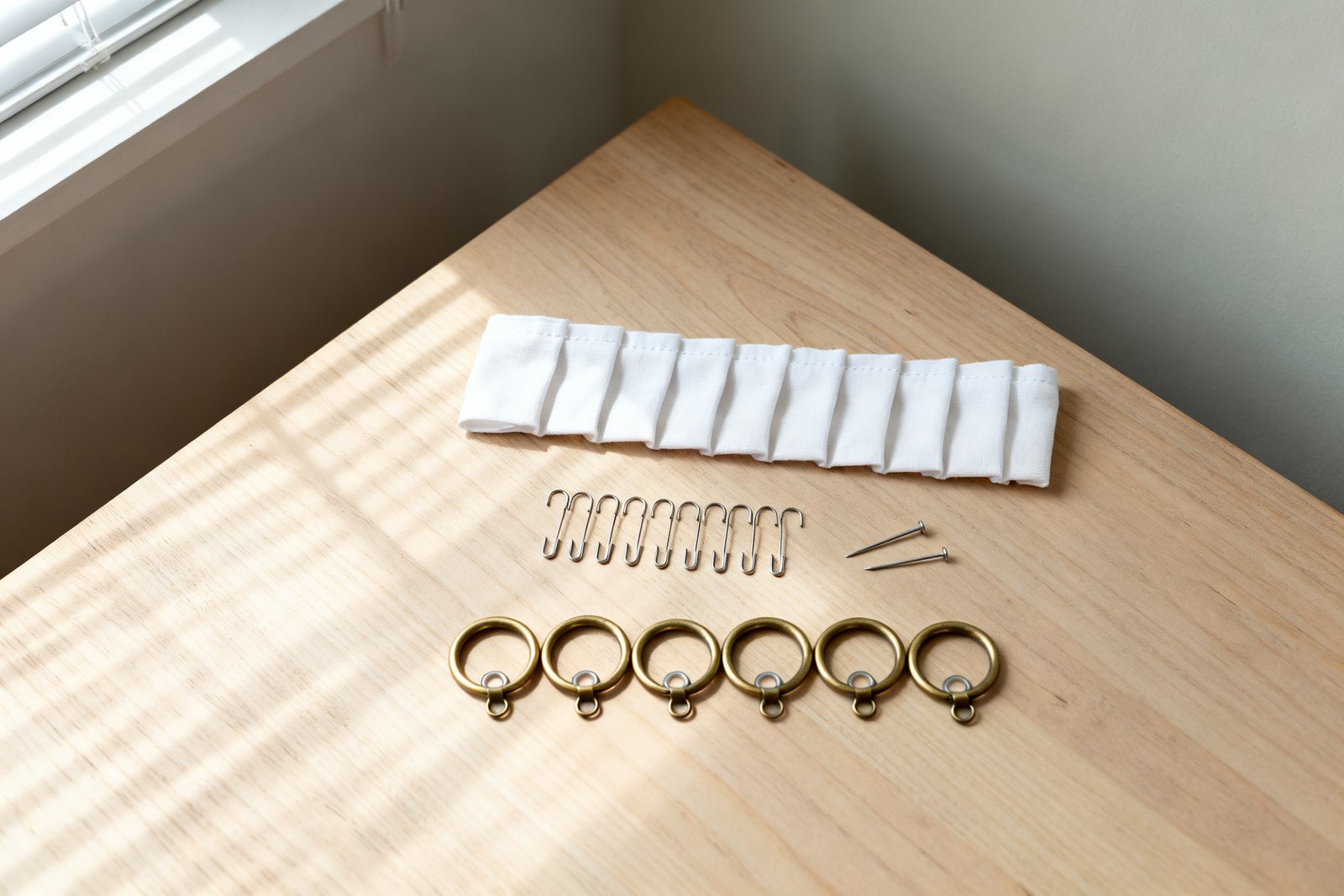
Most curtains you can buy hang on nothing you had to choose. An eyelet panel drops straight onto the rod through the rings punched into its own top; a tab-top loops over it; a rod-pocket swallows it whole. None of them take a hook. A smaller group, the pleated and taped headers, hang on hooks. And one part on that group, the pin, is the only real decision in the whole business. So the pieces that feel like an afterthought you grab at the till are mostly not a choice at all: the header you already picked has chosen them for you, and the single part it leaves open is the one that decides whether the curtain hangs straight and clears the floor. If you are still choosing the rod itself, start with curtain rods and hardware; this page is about the small parts that join the two.
Look at the top of the curtain before you buy a single hook
The fastest way to waste money on curtain hardware is to buy it before you have read the header. The top of the curtain tells you the whole system. A woven tape or a sewn pocket across the back means the curtain is built to take hooks: that is the pinch pleat, the pencil pleat, the goblet. A row of metal eyelets, a run of fabric tabs, or a plain sewn tunnel means it is built to take the rod itself, and a hook has nowhere to sit. Buy a pack of hooks for an eyelet panel and you have bought a part that has no home on the curtain. The vocabulary of the top edge is worth learning once, in curtain header styles, because it settles the hardware before you have spent anything.
Read the top edge, and you know the hardware
Eyelet
The rod threads through its own rings
No hooksTab-top
Fabric loops pass over the rod
No hooksRod-pocket
A sewn tunnel swallows the rod
No hooksPencil pleat
Hooks into a gathered tape
HooksPinch pleat
Pin hooks into sewn pleats
HooksGoblet pleat
Pin hooks into rounded cups
HooksGeometry and trade convention, not a product spec. The top edge of any panel tells you which of these it is.
Once the header says hooks, the only quantity that matters is how many. Too few and the fabric sags into little swags between them instead of standing in an even line across the top, and the load lands on fewer points and works each one loose over a season.
Rule of thumb
one every ~3 in
How many hooks a panel needs
One hook in the tape roughly every three inches across the full gathered width, one at each end, and one ring for every hook.
Space the hooks too far apart and the heading sags into little swags between them instead of standing in an even line; the weight also lands on fewer hooks and works them loose. Spacing set to the actual panel width, counted rather than guessed, is what makes the top of the curtain read as a straight edge.
Geometry and long-standing trade practice, not a brand claim. Check it with a tape measure, not with us.
Rings carry the curtain, and the rod has to let them pass
Rings are the one part that works with almost any header. A ring can carry a pleated panel by taking its hooks through the small eye underneath, or it can carry a plain panel by clipping straight onto the top edge. That flexibility is why a set of rings usually outlives the curtain it was bought for, and why the clip is worth keeping in mind for anything that was never sold as a curtain at all.
Another way to do it
Clip rings turn anything flat into a curtain
Clip-on rings bite onto the top edge of any flat panel, so a curtain with no header tape, a plain length of fabric, even a flat sheet, hangs as a curtain with nothing sewn.
The clip does the job the tape and hooks would have done, gripping the raw top edge instead of a stitched pocket. It is the fastest way to hang something that was never made to be a curtain, and the easiest heading to take down and wash, because nothing is fixed into the fabric.
An arrangement, not a recommendation to buy anything. It works with whatever you already own.
The catch is never the ring against the curtain. It is the ring against the rod. A ring has to pass the rod and every bracket the rod sits in, not just slide onto the ends. Size the inner diameter to the look of the rod alone and you can end up with rings that clear the plain rod but jam at the centre support, so the curtain glides for two feet and then stops dead where you have to drag it past by hand. The thicker the rod, the more this bites, which is the whole reason ring diameter and rod diameter are chosen together rather than one at a time.
What “hooks included” does not tell you
A listing that says curtain hooks included has told you almost nothing. It has not told you how many, so you cannot know whether the pack covers your width at a hook every few inches or leaves you three short. It has not told you whether those hooks fit the rings you already own, or the ones the same shop sells on a different page. And it has not said a word about the part that actually sets the finished height, which is where the pin goes. Included is reassurance, not information, and it is the one line on the page you can safely stop reading.
Two habits do more damage at this stage than any wrong purchase, and both come from treating the hook as trivial once it is in your hand.
Easy to get wrong
| The habit | What it costs | Instead |
|---|---|---|
| Pinning through the front of the tape Pin hooks pushed straight through the face of the heading tape instead of into the woven pockets behind it. | The pins show on the front of the curtain and drag out under the weight of the fabric, dropping the panel one hook at a time. | Feel for the woven pockets on the back of the tape and slide each pin up inside one; the tape is built with them for exactly this. |
| Rings that do not clear the rod Rings chosen to match the rod's look without checking that their inner diameter clears the rod plus its brackets. | The rings snag at every bracket, so the curtain stops instead of gliding and has to be tugged past each support by hand. | Size the ring's inner diameter a clear step above the rod diameter, and check one actually passes the centre bracket, not just the ends. |
Common failure modes and their fix. No product data on this card.
The pin is the one adjustment you get after the curtain is made
Where a header takes hooks, there are two kinds, and the difference lands here. A sew-on hook is stitched to the back of the tape and never moves. A pin hook, sometimes sold as a prong hook, pushes into the woven tape and can be moved later. Both carry the same weight, but only the pin gives you an adjustment after the curtain is hung.
Every other decision on a made curtain is fixed by the time it reaches you. The width is sewn, the drop is hemmed, the header is set. The pin hook is the exception. It does not sit in one place: it pushes into one of a ladder of woven pockets on the back of the tape, and the pocket you choose decides how far the curtain hangs below the ring. Push the pin into a higher pocket and the whole panel rises by roughly the depth of one pocket, lifting the hem off the floor and pulling the heading up until the rod or track disappears behind the fabric. Drop it a pocket and the curtain falls further while more of the heading stands proud above the rings.
Rule of thumb
one pocket ≈ 1 in
The pin sets the finished height
On a pin hook, the tape pocket you push the pin into decides how far the curtain drops below the ring: a higher pin gives a shorter drop and hides the track, a lower pin gives a longer drop and shows more heading above the rings.
The pin is the one adjustment a finished curtain still gives you. Move it up a pocket and the hem lifts off the floor by about an inch while the rod or track disappears behind the fabric; move it down and the heading stands proud above the rings. It is how you level a panel against a floor that is not.
Geometry and long-standing trade practice, not a brand claim. Check it with a tape measure, not with us.
That single adjustment is how you level a curtain against a floor that is not. Measure the drop you actually want first, hang the panel, then walk the pins up or down a pocket at a time until the hem sits where you meant it to. It is the closest a ready-made panel comes to being fitted to your window, and it is worth doing before you decide the panel hangs badly: most of what reads as a bad drop is a pin in the wrong pocket, not a fault in the curtain. Where the rod itself sits above the frame is a separate lever, covered in how high to hang them.
Three real pin hooks, and the fine print that separates them
Most curtains arrive with a bag of hooks in the box, so the accessory aisle is where you go to replace a set that has gone missing or to upgrade to one that does more. It is worth the look, because the parts that seem interchangeable are not. Three metal pin hooks, one from each of three merchants, show the spread.
The products compared here

Heavy Duty Drapery Pin Hooks (22 per bag)

S-Shaped Metal Pin Hooks (Pack of 32)

Adjustable Pin Hooks (Pack of 10)
Catalogue photography supplied by Half Price Drapes, Neutral Curtains, Two Pages, retrieved 2026-09-02. One photo per product: colourways are variants of the same curtain, not different products.
The prices do not line up, and they are not meant to: the packs are different sizes, so the sticker tells you little until you divide it by the count. Half Price Drapes sells 22 hooks in a bag, Two Pages 32 in a pack, Neutral Curtains 10. Work each back to a price per hook and the gap is about five to one, from a little over twenty cents to more than a dollar. That is a real difference, and it is the reason to read the basis rather than the headline figure.
What each price actually covers
| Brand | Listed | Basis |
|---|---|---|
| Half Price Drapes Heavy Duty Drapery Pin Hooks (22 per bag) | $4.99 | single price, one bag of 22 pin hooks; final sale, no returns |
| Two Pages S-Shaped Metal Pin Hooks (Pack of 32) | $20.00 | single price, one pack of 32 pin hooks |
| Neutral Curtains Adjustable Pin Hooks (Pack of 10) | $12.00 | single price, one pack of 10 pin hooks |
Not like-for-like. These figures rest on different bases, so they cannot be ranked against each other. Read what each price covers before comparing.
Source: official product pages from Half Price Drapes, Neutral Curtains, Two Pages, checked 2026-09-02. Fold & Light does not measure products; any percentage is the one that brand publishes.
The fine print matters more than the price. Half Price Drapes states that its hooks work with pleated and flat panels, the widest fit of the three, though the set is final sale with no returns. It is the least fussy about the header and the cheapest per hook.
Check it at the source
Half Price Drapes · Heavy Duty Drapery Pin Hooks (22 per bag)
Listed at $4.99
What that covers: single price, one bag of 22 pin hooks; final sale, no returns
See it at Half Price DrapesAffiliate link, disclosed: Fold & Light may earn on it, never as a surcharge to you, and it changes nothing about what Half Price Drapes asks. The figure is dated 2026-09-02 and only the merchant page is current. The image above comes from the Half Price Drapes listing, retrieved 2026-09-02.
Two Pages lists its S-shaped hooks at a height of 1 1/8 inches and names the headers they suit: French, Triple French, Goblet and Inverted Box Pleated. It is the specialist’s answer, specified for a pleated heading rather than sold as a catch-all.
Check it at the source
Two Pages · S-Shaped Metal Pin Hooks (Pack of 32)
Listed at $20.00
What that covers: single price, one pack of 32 pin hooks
See it at Two PagesAffiliate link, disclosed: Fold & Light may earn on it, never as a surcharge to you, and it changes nothing about what Two Pages asks. The figure is dated 2026-09-02 and only the merchant page is current. That picture belongs to Two Pages and was taken from the catalogue on 2026-09-02.
Neutral Curtains does the most interesting thing with the part. Its adjustable hook carries a ratchet that shifts the drop across a three-inch range, which is the mechanical version of moving the pin up or down a pocket, built into the hook instead of the tape. The catch is in the line most listings bury: Neutral states plainly that these are not suitable for flat hook or tape pleat headers. That one sentence is the compatibility check the other two leave you to work out for yourself, and it is exactly the fine print this page has been arguing you should read first.
Check it at the source
Neutral Curtains · Adjustable Pin Hooks (Pack of 10)
Listed at $12.00
What that covers: single price, one pack of 10 pin hooks
See it at Neutral CurtainsAffiliate link, disclosed: Fold & Light may earn on it, never as a surcharge to you, and it changes nothing about what Neutral Curtains asks. The figure is dated 2026-09-02 and only the merchant page is current. The image above comes from the Neutral Curtains listing, retrieved 2026-09-02.
Three curtains, three answers
Three readers walk away with three different parts.
If you are renting and cannot drill, the header matters less than the mount. A tension rod sprung inside the recess carries a light panel, and clip-on rings let you hang whatever you like from it with no hooks and no tape. Check the weight the rod is rated for before you fall for the fabric: a heavy panel will bow a tension rod and slide it down the wall by morning.
If you own a pleated curtain, the work is counting and setting. Count the hooks to the gathered width, one every few inches with one at each end, and leave the pin depth for last, adjusted on the wall against the real floor rather than guessed on the table.
If the curtain is heavy, everything scales up. More hooks, set closer together so no single one carries a swag of fabric, and rings with enough inner clearance to pass the brackets without catching under load. Weight is the thing that turns a small mistake in spacing or clearance into a curtain that drags or drops.
Worth doing
Keep a few spare hooks
Buy one small pack of hooks and rings beyond the count the width needs, and store it with the curtain rather than in a drawer.
Hooks are the part that vanishes at the wash and the part a shop stops stocking in your exact style. A spare pack costs almost nothing and saves rehanging a whole panel around the three hooks that walked off. It is the cheapest insurance on the rail.
A practical step, not a product claim. Nothing here depends on which brand you buy.
None of the three had to choose a hook from a catalogue. Each read the top of the curtain, counted to the width, and kept the one decision that was theirs, the pin, for the wall. That is the whole method: the header names the part, the width sets the number, and the pin sets the height.
Questions people ask about hooks, rings and pins
Which curtains actually need hooks? Pleated and taped headers: the pinch, pencil and goblet all hang on hooks pushed into a woven tape. Eyelet, tab-top and rod-pocket panels take none, because the rod threads through the curtain itself.
How many hooks and rings do I need? Roughly one hook every three inches across the gathered width, one at each end, and one ring per hook. Counting to the width, not guessing, is what keeps the top edge straight.
What is a pin hook, and where does the pin go? A pin hook (or prong hook) pushes into the woven pockets on the back of the tape rather than being sewn on. The pocket you choose sets the drop below the ring, so it also levels a hem against an uneven floor. Through the face of the tape, it shows on front and pulls out under load.
Can I hang a curtain with no header tape? Yes. Clip-on rings bite the top edge of any flat panel, so a length of fabric, or even a flat sheet, hangs as a curtain with nothing sewn.
Why do my rings stick on the rod? Their inner diameter does not clear the rod plus its brackets. Rings that pass the bare rod can still jam at the centre support: size up, and check one passes the middle bracket.