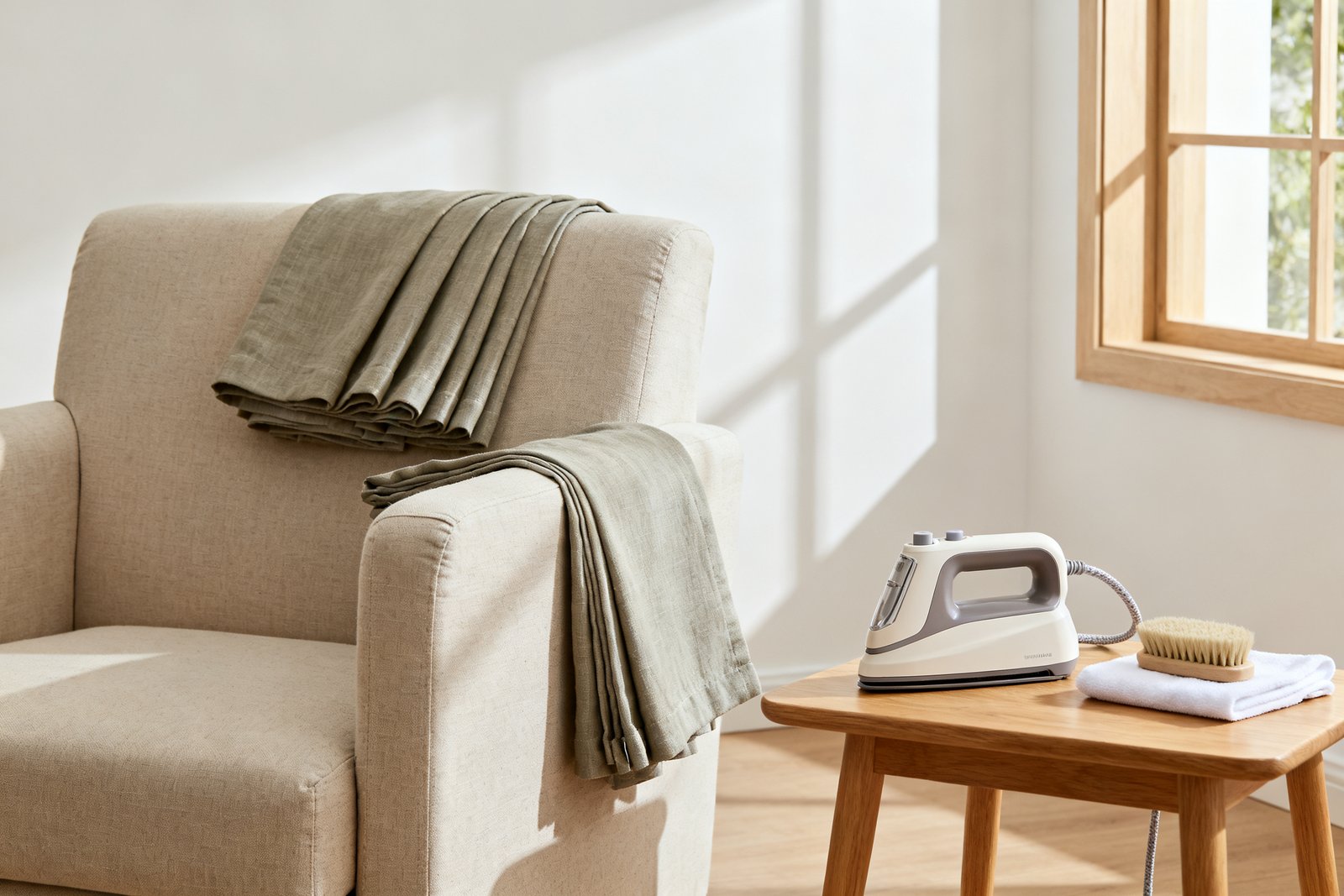
In the room

Listed at $89.99. base pleated panel, current price (regular around 99)
Catalogue photo from Neutral Curtains, retrieved 2026-08-22.
“Can I wash these?” is the first thing anyone asks about a curtain that cost more than a hundred dollars. It is also the question product pages answer worst, not because merchants hide the answer, but because they all print one, and the answers do not agree.
Read across eleven listings from three merchants in August 2026 and you get four different instructions for fabrics sitting side by side in the same catalogues. One merchant tells you to hand wash one of its linen panels and to dry-clean another. A second says dry clean or gentle machine wash, on the same page, in two different places. A third gives one instruction for its entire curtain range, word for word, whatever the fabric is made of.
If care labels described fibre, none of that could happen. Curtain care instructions are not describing the cloth, and this page is about what they describe instead, and about the one line, printed smaller than all the others, that matters more than any of them.
Four listings, four answers, and the fibre is not what separates them
Start with the disagreement, because it is sharper than it looks.
Two Pages prints Dry-clean only on its Patti panel, which its own spec table lists as 100% Belgian Linen at 248 gsm. On its Liz panel, 10% linen and 90% polyester at 350 gsm, the same merchant prints something else entirely: hand wash in warm or cold water, never hot; do not bleach; tumble dry on low heat or dry naturally.
Neutral Curtains sells a panel in 100% Belgian linen at 250 gsm, near enough the same cloth as the Patti, and allows what Two Pages forbids: dry clean, or gentle machine wash in cold water with mild detergent, then lay flat or hang to dry. Though that page cannot quite hold one position. The permissive version sits in the product description; the tab headed Care on the same listing gives two words, dry clean, and stops. The looser instruction is where the selling is done, the stricter one is where the commitment is made.
Half Price Drapes sells 100% Linen too, and closes the door again: the curtains should be dry cleaned only.
Three panels of pure linen. One says never wash it. One says wash it cold and gently. One says never wash it. And the panel that is nine parts polyester is the one you are actively told you may put in water.
Easy to get wrong
| The habit | What it costs | Instead |
|---|---|---|
| Washing a made-to-measure panel because the fabric could take it The care line is read as a fact about the cloth, so a fabric that sounds washable gets washed. | The cloth usually survives. The finished length is the part that does not, and a hem cut to your window cannot be let down again. A made-to-order panel is not returnable either, so the half-inch decision you paid for is simply gone. | Read what the listing says about dimensional change before you read what it says about the fabric. Merchants print that warning themselves, under the very method they recommend. |
Common failure modes and their fix. No product data on this card.
That is not a rounding error between merchants, and it is not carelessness. It is the first sign that the instruction is answering a different question from the one you asked.
What the fabric was made into decides more than what it was made of
The cleanest proof of that is inside a single merchant’s catalogue, on a single cloth.
Two Pages sells the Patti as a curtain and as a Roman shade. Both listings publish the same fibre and the same weight: 100% Belgian Linen, 248 gsm. Nothing about the cloth changes between them. The instruction changes completely. The curtain is Dry-clean only. The shade is Wipe clean.
The reason is structural, and it is visible in the shade’s own spec sheet. A Roman shade is not a length of fabric. It is fabric joined to a lift system and hung from a wood headrail measuring 3/4 by 1 1/2 inches, which is why the listing also demands 2 3/8 inches of minimum inside-mount depth. Wood, cords and battens are what make the folds stack; they are also what makes immersion a non-question. It is worth knowing how a Roman shade is actually built before deciding how to clean one. Nobody is deciding whether the linen could survive a wash. The assembly it now belongs to cannot.
In the room

Listed at $109.99. listed price (9 colourways, all at 109.99, no compare_at). Made-to-measure shade: size, lift, motorisation and Lining Type are billed through the conf
Catalogue photo from Two Pages, retrieved 2026-08-22.
Neutral Curtains says the same thing about its own Roman shade, and says it out loud rather than by implication: never machine wash, hand wash or immerse the Roman shade in water: it can cause shrinkage, fading or structural damage. That is the only place in these eleven listings where a merchant explains what happens if you use the method it forbids, rather than simply forbidding it, and it is on a shade, not on a curtain.
Follow the same logic one step further and you reach the cellular shade, where the fabric is bonded into honeycomb cells under an aluminium headrail and the merchant no longer offers a wet method at all: vacuum the dust off with the brush extension of a vacuum cleaner.
Curtain, Roman shade, cellular shade. Same direction every time: the more the cloth is built into something, the drier the instruction gets.
Straight from the listing
Two Pages · Patti Linen Deco Fold Roman Shade Cordless
Listed from $109.99
What that covers: listed price (9 colourways, all at 109.99, no compare_at). Made-to-measure shade: size, lift, motorisation and Lining Type are billed through the configurator.
Build your size at Two PagesAffiliate link. Fold & Light may earn a commission at no cost to you, and it does not change what Two Pages charges. The figure above is what the listing showed on 2026-08-22; the merchant’s own page is the price that counts. The photo is a catalogue shot from Two Pages, retrieved 2026-08-22.
Run the fibre test across three brands, and it fails
If fibre decided, the same fibre would get the same answer. It does not, in either direction.
The three pure linens are already listed above: never, sometimes, never. The three polyester velvets do it again. Two Pages publishes 100% Polyester Velvet at 300 gsm and then lists five instructions in a row (hand wash cycle; wipe clean; dry clean; do not bleach; do not wash in hot water) with no order of preference and no condition attached. Two of those are incompatible, and one of them, wipe clean, is a method for a hard surface, printed on a curtain cut from 110-inch-wide cloth. Neutral Curtains publishes 100% polyester velvet at 285 gsm and gives two words: dry clean. Half Price Drapes publishes a polyester velvet with a thermal lining (so the lining you are also cleaning is part of what you are handing over) and repeats its house sentence about dry cleaning only.
So a reader trying to work out what polyester velvet needs gets a shortlist of five, a single word, and a policy.
What each brand tells you to do, and to what
A panel that comes off the rod in one piece
- Two Pages Patti Premium 100% Belgian Flax Linen Curtain Pleated (same fibre, different instruction)
“Dry-clean only”
100% Belgian Linen · 248 gsm - Two Pages Liz Linen Drape Pleated
“Hand wash in warm or cold water, never hot. Do not bleach. Tumble dry on low heat or dry naturally.”
10% Linen, 90% Polyester · 350 gsm - Two Pages Birkin Velvet Curtain Pleated (same fibre, different instruction)
“Hand wash cycle. Wipe clean. Dry clean. Do not bleach. Do not wash in hot water.”
100% Polyester Velvet · 300 gsm - Neutral Curtains 100% Belgian Flax Linen Curtains & Drapes Pleated (same fibre, different instruction)
“Dry clean, or gentle machine wash in cold water with mild detergent, then lay flat or hang to dry.”
and, on the same page: “Dry clean.”
100% Belgian linen · 250 gsm - Neutral Curtains Maillard Velvet Curtains & Drapes Pleated (same fibre, different instruction)
“Dry clean.”
100% polyester velvet · 285 gsm - Half Price Drapes Earl Grey French Linen Room Darkening Curtain (same fibre, different instruction)
“The curtains should be dry cleaned only. Fold lines can be steamed out using an iron or garment steamer. Avoid making contact with the face fabric.”
100% Linen - Half Price Drapes Signature Velvet Blackout Curtain (Alabaster Beige)
“The curtains should be dry cleaned only. Fold lines can be steamed out using an iron or garment steamer. Avoid making contact with the face fabric.”
100% Polyester velvet with an off-white thermal lining
Cells that collapse
- Two Pages Aura Blackout Cellular Window Shades Cordless
“Vacuum the dust off with the brush extension of a vacuum cleaner. The fabric is anti-static and dust-repellent.”
100% Polyester · 225 gsm
Fabric that folds and stacks
- Two Pages Patti Linen Deco Fold Roman Shade Cordless (same fibre, different instruction)
“Wipe clean.”
100% Belgian Linen · 248 gsm - Neutral Curtains Lily Linen Roman Shades & Blinds | Plain Fold
“Wipe clean.”
Never machine wash, hand wash or immerse the Roman shade in water: it can cause shrinkage, fading or structural damage.
80% polyester, 20% linen · 350 gsm - Half Price Drapes Crisp White French Linen Roman Shade (same fibre, different instruction)
“Fold lines can be steamed out using an iron or garment steamer. Avoid making contact with the face fabric.”
100% Linen
7 of these listings share a published fibre with another listing here and carry a different instruction. One listing publishes no cleaning method at all, and we are not borrowing one from its neighbour.
Source: official product pages from Half Price Drapes, Neutral Curtains, Two Pages, checked 2026-07-21, 2026-08-20, 2026-08-21 and 2026-08-22. Fold & Light does not measure products; any percentage is the one that brand publishes.
What that gap costs you is practical, not academic. A 250 gsm linen panel that goes through a cold gentle cycle comes out softened and creased, and the instruction that follows the wash is the one that decides what it looks like afterwards: lay flat or hang to dry. Those two are not equivalent on a floor-length panel. Hung damp, the panel’s own weight pulls the creases down the length of the cloth and it dries in the shape it will hang in. Laid flat, it dries in the shape of the surface you left it on, and it goes back on the rod carrying that. The merchant offers both because both are safe for the fibre. Only one of them is safe for the drape. This is one more reason to treat choosing the fabric in the first place as a decision about upkeep and not only about looks.
And washing at home is only an option if you can get the panel down and back up. On a pleated header hung from a track at ceiling height, “gentle machine wash” is an instruction about a fabric, delivered to someone standing on a ladder.
In the room

This listing does not publish the figure.
Catalogue photo from Two Pages, retrieved 2026-08-22.
Straight from the listing
Neutral Curtains · 100% Belgian Flax Linen Curtains & Drapes Pleated
Listed from $89.99
What that covers: base pleated panel, add-ons excluded (page states 'Total Price = Base Price + Add-ons'); compare_at 99.99
Build your size at Neutral CurtainsAffiliate link. Fold & Light may earn a commission at no cost to you, and it does not change what Neutral Curtains charges. The figure above is what the listing showed on 2026-09-02; the merchant’s own page is the price that counts. The shot beside it is catalogue work by Neutral Curtains, pulled 2026-09-02.
The most synthetic fabric here is the only one you are allowed to wash
Put the two Two Pages panels side by side and the ranking most people carry into a showroom inverts.
The Patti is 100% Belgian Linen, 248 gsm: the premium option, the one with the origin in its name, and the one you are told to send out for dry cleaning every time. The Liz is 10% linen and 90% polyester, 350 gsm (a good moment to be clear about what the word linen is doing in a product name), the blend, the compromise, and the only curtain of the two you may put in water yourself.
In the room

This listing does not publish the figure.
Catalogue photo from Two Pages, retrieved 2026-08-22.
That is not a quirk of one merchant’s legal department. It follows from what the fibres do under heat and moisture. A majority-polyester cloth holds a pressed pleat through a wash and a low tumble dry, so the panel returns to the rod in the shape it left it. Pure linen relaxes. On a plain hem that shows up as softness, which is often the point of buying linen at all; on a pleated header it shows up as a header that no longer holds its shape, and the header is the part of a curtain you cannot re-press back into existence at home.
So the real ongoing cost of a curtain is not printed next to the price. It is printed in the care line. A panel you may wash costs a wash. A panel you may not costs a professional clean, every time, for as long as you own it, and on the merchant’s own numbers, the second panel is the one carrying the word premium.
Straight from the listing
Two Pages · Liz Linen Drape Pleated
Price shown at configuration
See the size options at Two PagesAffiliate link. Fold & Light may earn a commission at no cost to you, and it does not change what Two Pages charges. The figure above is what the listing showed on 2026-07-21; the merchant’s own page is the price that counts. The image above comes from the Two Pages listing, retrieved 2026-08-22.
The curtain care line that matters most is the smallest one on the page
Here is the sentence that should change how you clean a made-to-measure curtain, printed by Two Pages underneath the very method it recommends:
Steaming and drying processes may cause slight dimensional changes. Hang the curtains immediately after dry cleaning to minimize.
The merchant is saying that the cleaning it prescribes can move the finished size of the thing it made to your measurements.
Now stack that against what the same pages already tell you. The Patti and the Liz both publish a manufacturing tolerance: lengths vary by 1″ due to handcraft. Neutral Curtains publishes its own: 0.4 inch on the finished curtain size, from manual measurement. And the Patti’s hem is 1.5 inches deep.
A curtain length is a half-inch decision, and the gap between the hem and the floor is the whole of it. The panel arrives with up to an inch of variation already built in. Then the first clean is allowed to move it again. Neither shift is recoverable, because a made-to-order panel is cut to your window and is not returnable (this is the sharp end of what made-to-measure lets you change, and what it does not) and because a 1.5-inch hem is a finished detail rather than a reserve of cloth waiting to be let down.
Rule of thumb
½ in clear · touching · 2–3 in puddle
Where the hem should stop
Half an inch clear of the floor, touching it, or two to three inches of puddle. Nothing in between.
The three lengths are three deliberate looks: clean and practical, tailored, or soft and formal. An inch of daylight under the hem is none of them. It reads as a curtain ordered in the wrong size, which is exactly what it is.
Geometry and long-standing trade practice, not a brand claim. Check it with a tape measure, not with us.
This is the part no product page frames as a cost. Choosing a length is treated as the careful step, and cleaning as routine maintenance afterwards. On a made-to-measure panel it is the other way round: the measurement is protected by the workshop, and the cleaning is the moment it is put at risk.
The mitigation is in the same sentence, and it is free: hang it back up immediately, wet or damp, and let its own weight do the settling. Drying a panel anywhere other than on its rod is what turns a tolerance into a visible hem line.
Worth doing
Steam it on the rod, do not iron it flat
Hang first, steam second, from top to bottom, with the panel hanging free.
Ironing a panel flat presses in the creases you want gone and flattens the folds you want kept. Steaming on the rod lets gravity do the work, and the fabric sets into the shape it will actually hang in.
A practical step, not a product claim. Nothing here depends on which brand you buy.
What the listings do not say, and why that is a finding
One of these eleven listings publishes no cleaning method at all.
Half Price Drapes sells a Roman shade in 100% Linen, and the sentence that appears on every curtain it sells, the curtains should be dry cleaned only, is simply absent from it. What remains is the wrinkle advice: fold lines can be steamed out using an iron or garment steamer; avoid making contact with the face fabric. That tells you how to deal with creases from the box. It does not tell you what to do about a stain in a year.
Fold styles

Catalogue photo from Half Price Drapes, retrieved 2026-08-22.
We are not filling that gap. The merchant sells linen curtains it says to dry-clean, and it would be easy to carry that across to the linen shade on the next page. It would also be a guess, on a made-to-order product that cannot be returned, in a category where the same merchant’s own catalogue shows the instruction changing with construction rather than with cloth. The honest statement is the narrow one: this listing does not say.
The same merchant leaves a second blank. It publishes no fabric weight on any of the three products read here: not on the linen curtain, not on the velvet, not on the shade. We are not estimating one. Two of the three merchants print a gram figure on every panel; one prints none. That is not a scandal, but it is a real difference in what you can know before you pay, and it compounds with the missing care line on exactly the product where knowing would matter most.
Shade care runs dry, and that is the good news
The further a product moves from “a length of cloth”, the narrower the instruction gets, and the cheaper it gets to follow.
For the cellular shade, Two Pages gives one method and no alternative: vacuum the dust off with a brush extension, on a fabric it describes as anti-static and dust-repellent. Neutral Curtains gives its Roman shade a three-step routine in the same spirit: weekly dusting with a feather duster or a vacuum brush attachment, spot-cleaning by dabbing with a soft damp cloth and mild soap without rubbing, and professional dry cleaning when a thorough clean is needed.
Read as a chore list that sounds like more work than a curtain. Read structurally, it is less. A cellular shade collapses into a stack that closes dust inside the cells themselves, and those cells are lit from behind for most of the day, which is why dust in a honeycomb shows up as uneven greying long before the same amount of dust would register on a hanging panel. A weekly pass with a brush attachment is not housekeeping fussiness. It is the only maintenance available, because the method that would lift settled dust back out is the method the listing rules out.
Worth doing
Dust it weekly so you never need the wet method
Run a vacuum brush attachment down the shade once a week, with the shade fully lowered.
A shade that folds or collapses closes dust inside its own folds and cells, where it settles unevenly and shows up against the light coming through from behind. Every listing that rules out immersion recommends dusting instead, and dusting only works as prevention: once dust is set into the cells, the method that would lift it out is the one the listing forbids.
A practical step, not a product claim. Nothing here depends on which brand you buy.
The trade is worth stating plainly, because it runs opposite to price. The made-to-measure linen curtain carries a recurring professional cleaning bill. The shade carries a vacuum attachment.
Three readers, three answers
If you will never send curtains out to be cleaned, stop choosing fabric first. Choose a listing that authorises washing and says so in writing, then look at what it is made of. Of the eleven listings here, two do it unambiguously: one hand wash, one gentle cold machine wash. A third lists hand washing among five instructions that contradict each other, which is not the same thing and should not be read as one. Both of the clear two are pleated panels, and both belong to merchants that also sell dry-clean-only cloth in the same range, so this is a per-listing decision, never a per-brand one.
If you have already ordered made-to-measure, the fabric question is settled and the dimension question is not. Before the first clean, find the line about dimensional change, and treat the drying instruction as the operative one: back on the rod immediately, damp, rather than dried flat and rehung. That is where a published tolerance turns into a hem you can see.
If you are still choosing, ask the listing three questions it should be able to answer. What is the method for this finished product, not for this fabric. What does the recommended cleaning do to the finished dimensions. And what happens if neither answer is written anywhere on the page, on a product that cannot be sent back.
The last one is not rhetorical. One of the eleven listings read for this page fails it outright.

Straight from the listing
Neutral Curtains · Lily Linen Roman Shades & Blinds | Plain Fold
Listed from $35.99
What that covers: base price of the PLAIN FOLD only, add-ons excluded
Build your size at Neutral CurtainsAffiliate link. Fold & Light may earn a commission at no cost to you, and it does not change what Neutral Curtains charges. The figure above is what the listing showed on 2026-08-22; the merchant’s own page is the price that counts. The photo is a catalogue shot from Neutral Curtains, retrieved 2026-08-22.
Common questions
Can you machine wash curtains?
It depends on the listing, not on the fibre. Across the eleven listings read here, one curtain authorises hand washing outright (the Two Pages Liz, at 10% linen and 90% polyester) and one authorises a gentle cold machine wash, the Neutral Curtains panel in 100% Belgian linen. A third lists hand washing among five instructions that contradict one another. Every other curtain in the group is dry-clean only.
Are 100% linen curtains dry clean only?
Not consistently, which is the whole difficulty. Two Pages prints dry-clean only on its 100% Belgian Linen panel. Neutral Curtains allows dry clean, or gentle machine wash in cold water with mild detergent on a panel in the same fibre. Half Price Drapes prints the curtains should be dry cleaned only on its 100% Linen panel. Three merchants, one fibre, three positions.
Can you wash Roman shades?
The listings that answer say no. Two Pages and Neutral Curtains both give wipe clean for their Roman shades, and Neutral Curtains states the reason: never machine wash, hand wash or immerse the shade, because it can cause shrinkage, fading or structural damage. The Half Price Drapes Roman shade publishes no cleaning method at all, and we are not borrowing one from its curtains.
Will dry cleaning shrink my curtains?
Two Pages writes on its own product pages that steaming and drying processes may cause slight dimensional changes, and advises hanging the curtains immediately after dry cleaning to minimise it. No figure is published for how much, and we are not estimating one. What is published on the same pages is the manufacturing tolerance: lengths vary by 1 inch at Two Pages, and 0.4 inch on the finished size at Neutral Curtains.
How do you clean cellular and honeycomb shades?
Two Pages publishes a single method for its cellular shade: vacuum the dust off with the brush extension of a vacuum cleaner. It describes the fabric as anti-static and dust-repellent. That is the brand’s claim, not a measurement of ours. No wet method is offered on that listing.