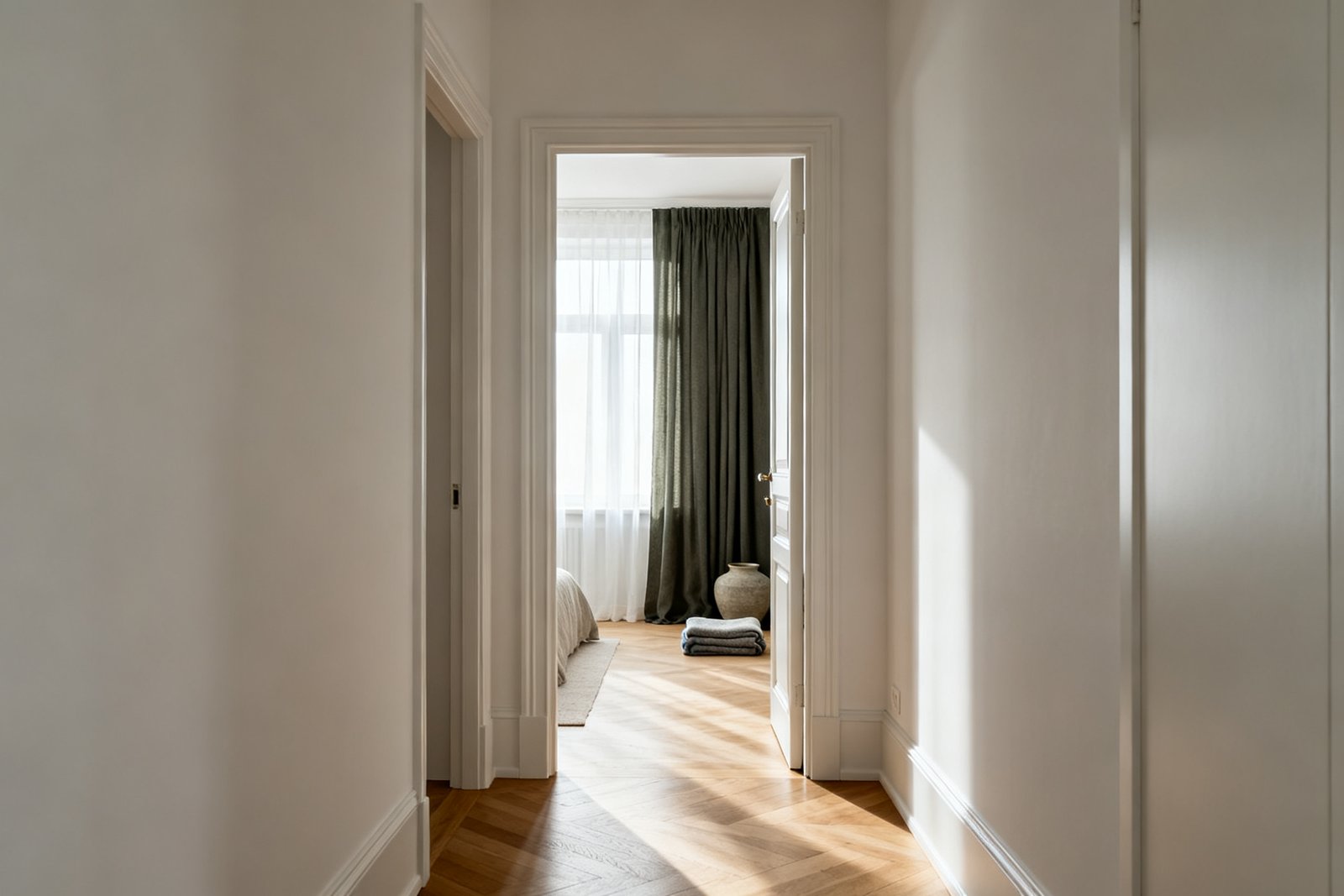
In the room

Listed at $68.99. listed starting price (7 colourways, all at 68.99, no compare_at). Size entered in the configurator.
Catalogue photo from Two Pages, retrieved 2026-08-22.
Twelve listings from three merchants were read on their own product pages between 21 July and 22 August 2026, with one question in mind: what does this page say that would help someone decide which room to put the product in?
Eleven of the twelve say something about light. Not one of them says anything about water, steam or washing.
Eleven of these twelve listings talk about light. Not one talks about water
That gap is not a detail. It is the shape of the whole category. A bedroom is a room the catalogue is willing to discuss, because darkness is a property of fabric and fabric is what these merchants sell. A bathroom is not. Neither is a kitchen, a laundry, or any other room whose real problem is condensation, splashing or cooking grease.
So a room-by-room guide has a choice. It can assign products to rooms on the strength of how they look in a photograph, which is what the phrase “room by room” usually means. Or it can start from what each room actually demands, check which of those demands the product pages answer, and be honest about the rest. Choosing on looks is a real decision, just a different one, and it is covered in what a style choice actually changes.
This page does the second one. It starts at the room, not at the product, and it says plainly where the evidence stops. There are no prices in this section, and that is deliberate: what a room asks for is not a budget question.
Every room asks the same four things; only the order changes
Strip away the styling and a room makes four demands, all of them testable.
How far down the fabric takes the light. Not the word on the label: the figure, or the absence of one.
Who works it, and whether a cord hangs. A window you reach over a sink is a different object from a window you pass twice a day.
Whether the thing physically fits. A shallow reveal rules out mechanisms that a budget never would.
What happens to the fabric when the room is wet, greasy or dirty. Steam, splashback, cooking oil, small hands.
Every room asks all four. Only the weighting moves. A bedroom leans hard on the first. A child’s room leans on the second. A small recessed window leans on the third. A kitchen and a bathroom lean almost entirely on the fourth, and the fourth is the one nobody publishes. If you want the family-by-family view of what each type of shade does with these four demands, that belongs in what each family of shades actually does.
Two of the four get an answer. Two of them do not
What a room asks for, and what the listings answer
| Someone sleeps hereNeeds the listing to publish: How dark the fabric actually goes | 11 of 12 · Half Price Drapes, Neutral Curtains, Two Pages1 listing carries no such field at all |
| A child can reach the windowNeeds the listing to publish: What lifts it, and whether a cord hangs | 5 of 12 · Half Price Drapes, Neutral Curtains, Two Pages7 listings carry no such field at all |
| The window sits in a shallow revealNeeds the listing to publish: Minimum depth for an inside mount | 3 of 12 · Neutral Curtains, Two Pages8 listings carry no such field at all |
| The opening is a fixed sizeNeeds the listing to publish: The smallest and largest size accepted | 4 of 12 · Half Price Drapes, Neutral Curtains5 listings carry no such field at all |
| The room gets steam, splashes or cooking greaseNeeds the listing to publish: Fabric care, washing, moisture behaviour | 0 of 12 · not a field on any listing we checked |
| A cord must not hang within a child's reachNeeds the listing to publish: A named child-safety standard the product meets | 0 of 12 · not a field on any listing we checked |
Counted across the 12 listings on this page. “Published by none” means the field was looked for on the product page and was not there. “Not a field on any listing we checked” is a weaker statement: it means we hold nothing on it either way, and it is not a claim that the brand publishes nothing anywhere.
Source: official product pages from Half Price Drapes, Neutral Curtains, Two Pages, checked 2026-07-21, 2026-08-20, 2026-08-21 and 2026-08-22. Fold & Light does not measure products; any percentage is the one that brand publishes.
Read the counts rather than the design. Opacity appears on eleven of the twelve listings. A lift mechanism appears on five. A published size range appears on four. A minimum mount depth appears on three. Fabric care, washing and moisture behaviour appear on none. A named child-safety standard for cords appears on none.
The two blank rows are the important ones, and they need reading carefully, because a cell can be empty for two very different reasons and collapsing them would be a lie. There are three states behind that table, not two:
- Published. The figure is on the product page and this article quotes it, attributed to the brand that printed it.
- A checked silence. The field was looked for on the page and was not there. Two Pages publishes no fabric weight for the Alvin Boutique roller, no minimum mount depth for it and no size range for it, while publishing all three for other shades in the same catalogue. Saying “the brand does not publish the number” is fair here.
- Nothing held either way. Nothing in the evidence behind this page touches washing, moisture or cooking grease on any of the twelve listings, and nobody went looking. That gets weaker wording, and it earns it.
So this article never claims these brands publish nothing about caring for a fabric. It claims the record behind it contains nothing on the subject, which is exactly why the last section is a list of questions rather than a list of answers.
The same discipline applies to size. Four listings publish a range, three publish a checked silence, and five carry no such field at all. If your window sits at the edge of what a product will be made in, what the merchant takes off the size you give and a window whose measurements fall outside what the listing publishes are the two places that question is worked through properly.
On darkness, the word on the label is not the number on the page
Darkness is the one demand the catalogue answers almost everywhere. It answers it in four different vocabularies.
Two Pages prints Blackout Rate: 100% in the Specifications block of the Alvin Boutique roller shade. On its Aura cellular shade, also sold as blackout, it publishes no percentage at all and describes instead a high-density fabric with an aluminium-coated interior. Neutral Curtains claims a dark color shading effect of over 95 percent on its Maillard velvet, and conditions it on the dark colourways, which makes it a claim about some of the thirty-seven colours and not about the product. Half Price Drapes publishes 20% sheer opacity on an unlined voile panel.
Opacity, as each brand states it
Two Pages says
blackout claimed by the brand, no percentage published
Two Pages says
Blackout Rate: 100%, as the brand states it
Two Pages says
light filtering claimed by the brand through alternating sheer and opaque stripes, no percentage published
Two Pages says
blackout from heavy fabric plus a configurable blackout thermal lining
Neutral Curtains says
non-blackout (base)
Neutral Curtains says
dark color shading effect of over 95 percent
Neutral Curtains says
blackout and light filtering offered as separate options; no percentage published
Half Price Drapes says
blackout (fabric)
Half Price Drapes says
20% sheer opacity as published by the brand; unlined panel, no backing
Half Price Drapes says
brand states the privacy lining blocks approximately 60-65% of incoming light
Half Price Drapes says
room darkening (fabric)
These are manufacturer claims, quoted as published. They are not measurements taken by this site, and the vocabulary is unregulated.
Source: official product pages from Half Price Drapes, Neutral Curtains, Two Pages, checked 2026-07-21, 2026-08-20, 2026-08-21 and 2026-08-22. Fold & Light does not measure products; any percentage is the one that brand publishes.
Then there is the case that makes the point on its own. Half Price Drapes sells a shade titled Light Ochre Solid Cotton Blackout Tie-Up Window Shade. On that same page, answering its own question about how much light the shade blocks, the brand states that the Privacy Lined backing blocks approximately 60-65% of incoming light. The wording is identical, word for word, to the page of its twin, the Millstone Grey shade titled Room Darkening. Same price, same 46 by 63 inch size, same construction. One wears the word “Blackout” and one does not, and nothing else separates them.
Now put that beside the first figure. The strongest darkness claim in this set, a flat 100%, sits on the listing that publishes no fabric weight, no mount depth and no size range. The most cautious one sits on a shade that publishes all three. The number is loudest where the rest of the page is quietest. Where these words sit relative to each other is the subject of the opacity ladder; what matters here is that the label is not the measurement.
Straight from the listing
Two Pages · Aura Blackout Cellular Window Shades Cordless
Listed from $68.99
What that covers: listed starting price (7 colourways, all at 68.99, no compare_at). Size entered in the configurator.
Build your size at Two PagesAffiliate link, and worth saying plainly: we may be paid a commission if you buy through it, it costs you nothing extra, and Two Pages pricing is untouched. What you see here is a reading taken on 2026-08-22; check the listing itself before you order. The shot beside it is catalogue work by Two Pages, pulled 2026-09-02.
On one listing, the room you get depends on a finishing part
In the room

Listed at $42.99. listed starting price (11 colourways, all at 42.99, no compare_at). Made to measure: width and height are chosen in the page's size selectors, so this
Catalogue photo from Neutral Curtains, retrieved 2026-08-22.
Neutral Curtains writes something on the Tavi roller shade page that almost no listing writes anywhere: “For 100% blackout, please select the front valance. Back valance may let light in from the sides, since the headrail depth is around 2 inches.”
Read that as a room statement. The same fabric, ordered two ways, gives you a bedroom or gives you a bedroom with light down both edges, and the difference is a dropdown, not a textile. The brand also states that its factory takes 3/8 of an inch off the width, that the deduction lands on the headrail rather than the fabric, and that side gaps follow.
Two Pages numbers the same problem on a different product. On the Brio zebra shade it states that the fabric will be 1 1/2 inches narrower than the shade and cassette width, because the width you order is the width of the tube, not of the cloth. It is the only listing in this verified set that puts a figure on its own light gap. What a roller does with a reveal, and what it leaves uncovered, is worked through in roller shades and blinds.
Depth decides before any of that does.
Minimum window depth for an inside mount
Neutral Curtains
3 5/8 in
Tavi Roller Shades
Two Pages
2 7/8 in
Brio Light Filtering Zebra Shade Cordless
Two Pages
2 in
Aura Blackout Cellular Window Shades Cordless
Measure the reveal before choosing a fabric. A shallow frame rules options out faster than a budget does.
Source: official product pages from Half Price Drapes, Neutral Curtains, Two Pages, checked 2026-07-21, 2026-08-20, 2026-08-21 and 2026-08-22. Fold & Light does not measure products; any percentage is the one that brand publishes.
Three listings out of twelve publish a minimum inside-mount depth: 2 inches for the Aura cellular, 2 7/8 inches for the Brio zebra, 3 5/8 inches for the Tavi. The Aura and the Brio each publish a second, higher figure for a flush mount as well: 2 1/4 and 3 1/2 inches.
The Tavi figure needs both of its numbers said together. Its Specifications block gives 3 5/8 inches. Its FAQ, further down the same page, answers “2 inches” to the question of minimum depth, in a passage that talks about roman shades on a roller shade listing. We record 3 5/8 inches and we quote the divergence. We do not hand you one figure and let you drill.
Straight from the listing
Neutral Curtains · Tavi Roller Shades
Listed from $42.99
What that covers: listed starting price (11 colourways, all at 42.99, no compare_at). Made to measure: width and height are chosen in the page's size selectors, so this figure is a floor.
Build your size at Neutral CurtainsAffiliate link, and worth saying plainly: we may be paid a commission if you buy through it, it costs you nothing extra, and Neutral Curtains pricing is untouched. What you see here is a reading taken on 2026-08-22; check the listing itself before you order. The image above comes from the Neutral Curtains listing, retrieved 2026-09-02.
A wall of window is a fixed width at one merchant and a range at another
In the room

Listed at $95.14. ready-made panel, fixed 100 in width, priced by length: 84L $95.14 / 96L $99.74 / 108L $105.01 / 120L $111.59; no width choice
Catalogue photo from Half Price Drapes, retrieved 2026-08-22.
Ask two of these merchants for something wide enough to cover a media room wall and you get two incompatible kinds of answer.
Half Price Drapes offers Extra Wide as a single fixed width of 100 inches, sold in four lengths: 84 inches at $95.14, 96 at $99.74, 108 at $105.01, 120 at $111.59. There is no width to choose. The panel is a stock item and the only variable is how far down it goes.
Neutral Curtains answers the same question with a range. The Tavi is made from 21 to 80 inches wide and 20 to 119 inches long, in eighth-of-an-inch steps. Anything wider than 80 inches is not a difficult window at that listing. It is outside the catalogue.
These two prices are not comparable and this page does not rank them. One is a ready-made panel priced by length, the other is a floor for a made-to-measure shade whose final figure depends on the size you enter.
One more thing about the wide panel, because the name says something the specification does not. Performance Linen is 100% polyester. The word describes an appearance, not a fibre. And the panel carries a compare-at price of $172.99 to $179.99 under a “50% OFF” badge that is displayed continuously. That is merchandising, not a sale, and this page does not relay it as one.

Straight from the listing
Half Price Drapes · Performance Linen Hotel Blackout Curtain (Extra Wide)
Listed at $86.50
What that covers: ready-made panel, fixed 100 in width, priced by length: 84L $86.50 / 96L $87.50 / 108L $89.00 / 120L $98.99; no width choice
See the size options at Half Price DrapesAffiliate link, and worth saying plainly: we may be paid a commission if you buy through it, it costs you nothing extra, and Half Price Drapes pricing is untouched. What you see here is a reading taken on 2026-09-12; check the listing itself before you order. The photo is a catalogue shot from Half Price Drapes, retrieved 2026-09-12.
The cheapest shade here was never meant to move
In the room

Listed at $10.50. price of the single ready-made size, 46W x 63L. Sold per shade, nothing to configure.
Catalogue photo from Half Price Drapes, retrieved 2026-08-22.
The Light Ochre tie-up shade costs $10.50 in the single ready-made size Half Price Drapes offers it in, 46 inches wide by 63 long, with nothing to configure. It is 100% cotton in a solid twill with an off-white lining, and it takes a rod up to 1 1/2 inches in diameter.
It also has no lift mechanism at all. What Half Price Drapes publishes in place of one:
- a 4 inch pole pocket that slides straight onto the rod;
- two fabric ties, 70 inches each, that gather the shade by hand;
- no rings and no clips, because the listing states none are needed or supplied.
The brand says the rest itself: this is a stationary product, not designed to be raised and lowered daily the way a roman or a roller is.
That is a room fact, and it is a useful one rather than a criticism. A window you open every morning, or one above a kitchen sink that you reach past while cooking, is not this shade’s window. A landing, a spare room, a window you dress once and leave, those are. The price makes sense once you know what the price is for.
And then there is the listing that carries a room in its own name. Two Pages sells Liz Linen Pleated Cafe Curtains, the half-window style that every kitchen article in the world reaches for. Its verified record holds exactly one usable figure: 350 gsm. No fibre content, no price, no opacity, no photograph. On the product named after the room. We are not borrowing a composition from a neighbouring Liz panel to fill the gap, and neither should you.
In a living room, the light you keep is a paid option
In the room

Listed at $89.99. base pleated panel, current price (regular around 99)
Catalogue photo from Neutral Curtains, retrieved 2026-08-22.
The rooms where you want light to come through are the rooms where the base price stops meaning what you think it means.
Neutral Curtains sells a 100% Belgian linen pleated panel at 250 gsm, listed from $89.99. The base is non-blackout, and that is not a shortcoming. It is the product. Blackout on that panel is a paid add-on lining, which means the version most people picture when they read the listing is not the version the price refers to.
The same brand’s Maillard velvet is 100% polyester at 285 gsm, listed from $65.99, and the page states the arithmetic outright: Total Price = Base Price + Add-ons. It comes with curtain hooks; rings are chosen separately and the rod is sold separately. The finished size carries a stated tolerance of 0.4 inches.
Half Price Drapes takes the other route with its double-layered voile: 20% sheer opacity by the brand’s own figure, unlined, no backing, sold in the same fixed 100 inch width across four lengths.
Three ways to keep daylight, three different things the first number covers. Which is why we are not putting them in order. How a made-to-measure total is actually assembled is what you pay for on a custom order.
Straight from the listing
Neutral Curtains · 100% Belgian Flax Linen Curtains & Drapes Pleated
Listed from $89.99
What that covers: base pleated panel, add-ons excluded (page states 'Total Price = Base Price + Add-ons'); compare_at 99.99
Build your size at Neutral CurtainsAffiliate link, and worth saying plainly: we may be paid a commission if you buy through it, it costs you nothing extra, and Neutral Curtains pricing is untouched. What you see here is a reading taken on 2026-09-02; check the listing itself before you order. The image above comes from the Neutral Curtains listing, retrieved 2026-09-02.
What to ask, in exact words, before you buy for a wet room or a child’s room
Two of the four demands a room makes are answered on these pages. The other two have to be asked. Copy these.
“Is this fabric washable, and how? Does the listing state care instructions anywhere?” Nothing in the evidence behind this page touches washing, steam or moisture on any of the twelve listings. Ask before you hang anything in a bathroom, a laundry or over a hob.
“Does this product meet a named child-safety standard for cords, and which one?” Five of these twelve publish a lift mechanism. None publishes a standard. Cordless is a description of a mechanism; it is not a certificate, and no page here offers one.
“What is your minimum inside-mount depth, and does the figure in your Specifications block match the one in your FAQ?” One listing in this set answers that question twice, with two different numbers, on the same page.
“Does the blackout depend on a valance or a side channel I have to select, or on the fabric alone?” One brand tells you unprompted. The rest leave you to find out after installation.
The rule worth keeping: check which of your room’s four questions the listing is willing to answer before you decide the product is right for the room. If it answers none of them, the problem is not your window.
Questions people ask
Which of these shades is safe for a bathroom?
None of the twelve listings behind this page publishes anything about moisture, washing or care, and the evidence we hold contains nothing on it either way. That is not the same as saying these brands publish nothing anywhere. It is why the honest answer is the question in the section above, put to the merchant before you buy.
Do blackout shades really block all the light?
Two Pages states Blackout Rate: 100% on its Alvin Boutique roller. Neutral Curtains states that 100% blackout on its Tavi shade depends on selecting the front valance, because the back valance may let light in from the sides. Half Price Drapes sells a shade titled Blackout whose own page says the lining blocks approximately 60-65%. Three brand claims, three different meanings, none of them measured by this site.
What is the minimum window depth for an inside-mount shade?
Three of the twelve publish one: 2 inches for the Aura cellular shade, 2 7/8 for the Brio zebra, 3 5/8 for the Tavi roller. The Aura and the Brio publish a second, higher figure for a flush mount: 2 1/4 and 3 1/2 inches. On the Tavi, the Specifications block says 3 5/8 inches and the FAQ on the same page answers “2 inches”; both figures are worth having in front of you.
Is a cordless shade the same thing as a child-safe shade?
No, and nothing on these pages lets you treat it as such. Five listings publish a lift mechanism: cordless on the Aura, the Alvin and the Brio, corded on the Tavi, and no lift at all on the Half Price Drapes tie-up. Not one publishes a named child-safety standard.
Can a single panel cover a whole wall of window?
It depends which merchant you ask. Half Price Drapes sells Extra Wide as a fixed 100 inch width in four lengths, with no width choice. Neutral Curtains makes the Tavi from 21 to 80 inches wide and 20 to 119 inches long in eighth-inch steps. Two opposite answers, and two price bases that should not be compared.