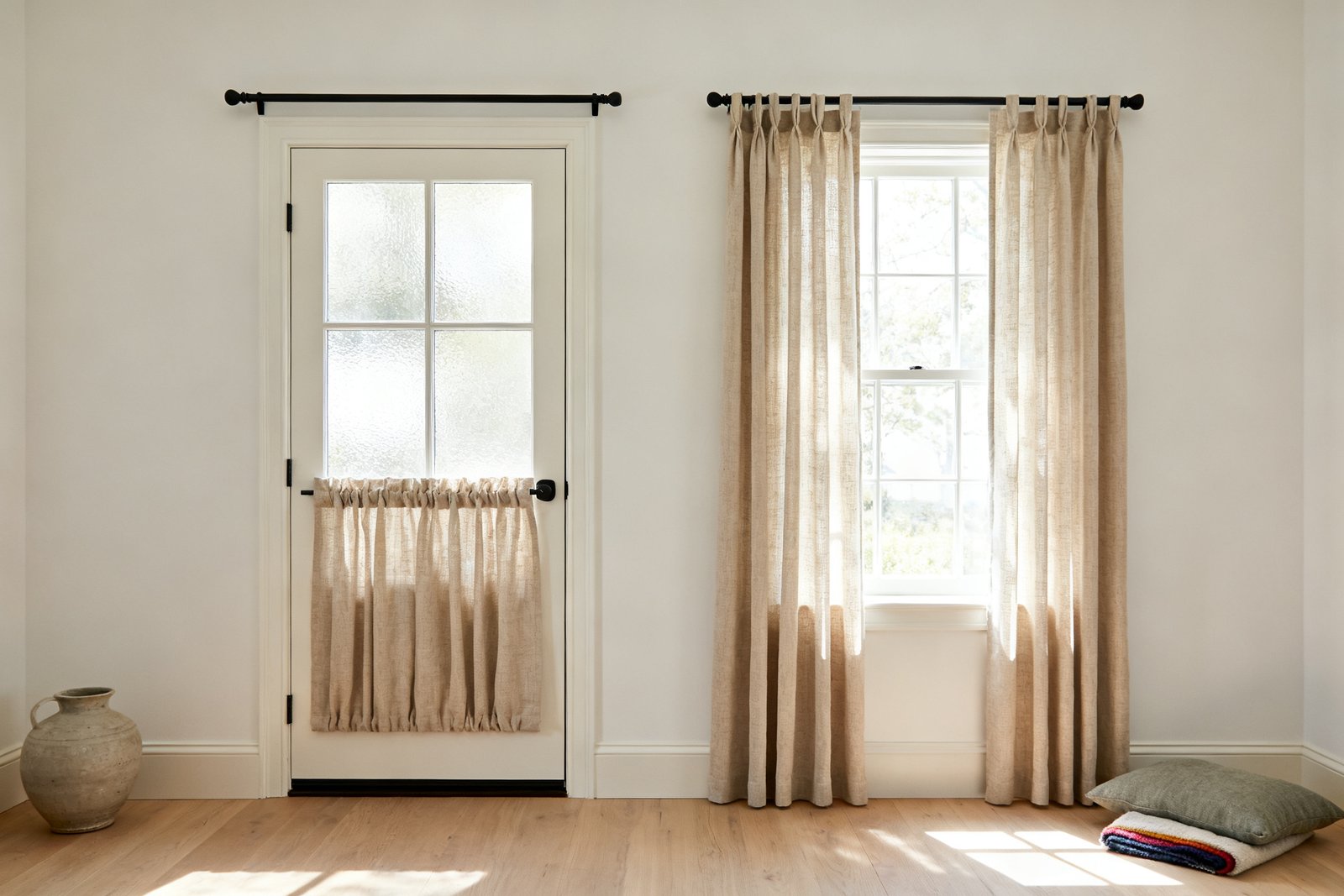
You have a door and a window in the same room. Often they sit on the same wall, a few feet apart, and whatever you put on one makes the other look wrong. Curtains on the window leave the door bare. A blind on the door leaves the window undressed beside it. So the instinct is to match them: same fabric, same length, same fullness, problem solved. That instinct is what makes most door and window treatments look accidental instead of planned.
It is the wrong instinct, and it is worth knowing why before you spend anything. A door is tall and a window with a sill is not. Give them the same fullness and the same length and the window looks starved while the door looks heavy, because the numbers that flatter one opening are the wrong numbers for the other. What holds a door and a window together is not sameness. It is a shared line and a shared family of fabric, each piece cut to its own size. Coordinate the line, not the size.
First, work out whether it is one wall or two
Before any fabric decision, settle a geometric one: where do the two openings sit in relation to each other? There are only a few answers, and each one opens a different set of moves.
If the door and the window share a wall and sit close, with a short run of plaster between them, you can treat the pair as a single opening. If they share a wall but sit well apart, you align them at the top and dress them separately. If they are on adjacent walls, you see both in one glance from the middle of the room, so they have to agree, but they do not have to line up. And if they are on different walls that never fall into the same view, they are two independent decisions, tied only by the room’s general palette.
The relationship is a fact about the space, not a matter of taste, and it decides more than the fabric ever will. It gives you a short ladder, from the most tied-together to the most independent, and your job before you shop is to find which rung your wall is on.
| Where the door and window sit | The move | Keep the same | Let differ |
|---|---|---|---|
| Same wall, close together | Treat as one | One rod, one continuous sweep of fabric | Nothing: it is a single treatment |
| Same wall, well apart | Align as two | Header line, fabric, colour | Fullness and length, scaled to each opening |
| Adjacent walls, both in one glance | Coordinate | Fabric family and colour | Mechanism, header height, sizing |
| Different walls, never in one glance | Leave free | Room palette only | The treatment, entirely |
Most people start at “match everything” by reflex, when the wall only ever needed a rung or two down from there.
The header is the one line that has to agree
If you change one thing across a door and a window, change where the treatment begins at the top. A door with no sill runs from the floor, and a window with a sill starts higher off the ground, so the two frames end at different heights on the wall. Follow each frame with its own rod and you hang two treatments on two lines, and the pair reads as an accident of construction rather than a choice.
Set both rods on a single line instead, above the taller opening, which is the door. Whatever sits at the top of the curtain is what a room reads as the top of the opening, so lifting the window’s rod up to the door’s line makes the shorter window read taller and makes the two openings look chosen together. It asks for a longer window panel and nothing else.
That shared line usually means mounting both outside the frame rather than inside the reveal. An outside mount covers the frame and reads larger, and it is the one that lets the door and the window carry the same clean rectangle at the same height.
Rule of thumb
2–4 in overlap per side
Inside or outside the reveal
Inside keeps the frame visible and leaks light at the sides. Outside covers the frame, needs two to four inches of overlap per side, and reads larger.
This is a proportion decision disguised as a fitting decision. An inside mount keeps a handsome frame on show and accepts a strip of daylight down each edge. An outside mount gives a clean rectangle that makes a small or awkward window look bigger, and it is the only one of the two that gets close to a dark room.
Geometry and long-standing trade practice, not a brand claim. Check it with a tape measure, not with us.
On a door the choice is made for you, and it is worth seeing how. A roman shade, the natural pick for a door that a swinging panel would foul, has to sit in a reveal deep enough to hold its headrail. The three linen shades here ask for two and a half to two and three-quarter inches of depth before an inside mount is even possible, and a door has no usable reveal at all. So a door shade mounts on the face of the frame by necessity, which is the same outside line the window should take to match it.
Minimum window depth for an inside mount
Half Price Drapes
2 3/4 in
Crisp White French Linen Roman Shade
Two Pages
2 1/2 in
Liz Linen Roman Shade Cordless
Neutral Curtains
2 1/2 in
100% Belgian Flax Linen Roman Shades & Blinds
Measure the reveal before choosing a fabric. A shallow frame rules options out faster than a budget does.
Source: official product pages from Half Price Drapes, Neutral Curtains, Two Pages, checked 2026-07-21, 2026-08-20, 2026-08-21, 2026-08-22 and 2026-09-02. Fold & Light does not measure products; any percentage is the one that brand publishes.
Fullness and length are the two numbers you never copy
This is where matching turns against you. Fullness is a ratio, not a width: it is how much fabric you gather relative to the opening. A narrow window and a wide door set to the same fullness do not look alike. The window gathers into a few dense folds and the door spreads the same ratio thin, so the pair ends up mismatched in the one thing anyone notices, the drape. Scale the fullness to each opening and they read as a set. The trap is the reverse: ordering each panel to the bare width of its own opening, so neither one has the cloth to close or to fold.
Easy to get wrong
| The habit | What it costs | Instead |
|---|---|---|
| Buying two panels that cannot close Two panels are ordered to match the window width, so together they are barely wider than the rod. | Closed, they pull flat and gap in the middle. Open, they have no folds. They become decoration on either side of a window rather than curtains. | Total panel width of at least twice the rod width. If that means four panels instead of two, it means four panels. |
Common failure modes and their fix. No product data on this card.
Length behaves the same way, and the door’s job gets in the way. A door panel has to clear the threshold and get pushed aside daily, so it lives at floor length, often with a hold-back on the hinge side to keep it off the swing. A window with a sill can stop at the sill or drop to the floor, but it is a still panel nobody touches. Cut both to the same number and one is working against its own opening; cut each to its own and the pair looks deliberate.
Make them one treatment, or two that agree
When the door and the window share a wall with a short run between them, stop treating them as two problems. Run one continuous rod across both and let the fabric sweep the whole span. The wall becomes a single wide feature instead of two openings with a strip of plaster between them, and the stack of gathered fabric lands outside both frames rather than bunching in the gap.
Another way to do it
One rod across two windows
Where two windows share a wall with a short run between them, hang a single continuous rod across both and treat them as one opening.
Two narrow windows dressed separately read as two narrow windows and a strip of wall. Dressed as one, the wall becomes a single wide feature and the room reads calmer. It also puts the stack outside both frames rather than between them.
An arrangement, not a recommendation to buy anything. It works with whatever you already own.
When they cannot share a rod, coordination can mean the opposite of matching. A glass door often wants a hard treatment for its function, a shade that pulls clear of the swing, while the window beside it wants soft panels. Forcing the same mechanism on both usually breaks the room and the function at once. Coordinate the colour and the fabric family instead, and let the mechanisms differ.
The cleanest coordination is one fabric in two mechanisms
The move that needs the least judgement is to buy a single fabric line as both a shade and a panel: the shade for the door, the panels for the window. You get the same cloth and colour on both openings, and each one gets the mechanism it needs, the flat shade that clears the swing, the soft panels that stack off the glass. It is the “coordinate, do not match” rule made literal, and all three brands here happen to sell exactly this pairing.
Two Pages runs its Liz Linen line as a pleated drape and a cordless roman shade, the same fabric in the two mechanisms this problem asks for.
In the room

This listing does not publish the figure.
Catalogue photo from Two Pages, retrieved 2026-08-22.
In the room

Listed at $59.99. listed floor price, identical on all 38 colourways, no compare_at. Made-to-measure: size, lift…
Catalogue photo from Two Pages, retrieved 2026-08-22.
One caveat, the kind the label hides. Two Pages’ own spec lists Liz Linen at ninety percent polyester and ten percent linen, in both the drape and the shade. It is a linen look, not linen fibre. The drape is the heavier make at three hundred and fifty grams per square metre, enough to hang in a deep and steady fold; the brand does not publish a weight for the shade. If the look is what you want, the line delivers it on both openings. If you want the fibre, two of the three brands here give it to you.
Read it on the merchant’s page
Two Pages · Liz Linen Drape Pleated
Price shown at configuration
See the size options at Two PagesAffiliate link, and worth saying plainly: we may be paid a commission if you buy through it, it costs you nothing extra, and Two Pages pricing is untouched. What you see here is a reading taken on 2026-07-21; check the listing itself before you order. Photograph from the Two Pages catalogue, retrieved 2026-08-22.
Neutral Curtains runs the same idea in real linen. Its hundred percent Belgian flax line comes as a pleated drape and a roman shade, both published at two hundred and fifty grams. Same fibre, same weight, two mechanisms, which is about as literal as coordinating a door and a window gets.

Read it on the merchant’s page
Neutral Curtains · 100% Belgian Flax Linen Curtains & Drapes Pleated
Listed from $89.99
What that covers: base pleated panel, add-ons excluded (page states 'Total Price = Base Price + Add-ons'); compare_at 99.99
Build your size at Neutral CurtainsAffiliate link, and worth saying plainly: we may be paid a commission if you buy through it, it costs you nothing extra, and Neutral Curtains pricing is untouched. What you see here is a reading taken on 2026-09-02; check the listing itself before you order. Catalogue photography supplied by Neutral Curtains, retrieved 2026-09-02.
Half Price Drapes is the third, its French Linen sold as the Earl Grey curtain and the Crisp White roman shade, both hundred percent linen. One flag before you read the number: both HPD listings wear a permanent “fifty percent off” badge against a fixed anchor. That is merchandising, not a sale, so read the figure as the price and not as a deal.

Read it on the merchant’s page
Half Price Drapes · Earl Grey French Linen Room Darkening Curtain
Listed at $99.96
What that covers: single ready-made panel; the listed figure already carries a standing '50% OFF' badge, a permanent anchor rather than a sale, and the real list price is unverified
See the size options at Half Price DrapesAffiliate link, and worth saying plainly: we may be paid a commission if you buy through it, it costs you nothing extra, and Half Price Drapes pricing is untouched. What you see here is a reading taken on 2026-08-20; check the listing itself before you order. Photograph from the Half Price Drapes catalogue, retrieved 2026-08-22.
Three prices that look comparable, and are not
Before you let one of these look cheaper than another, see why you cannot line them up. A panel sold through a configurator shows a floor, with size, lining and header billed on top. A roman shade shows a made-to-measure base that a width-by-length calculator rewrites. A ready-made curtain shows a fixed figure, sometimes behind a standing discount. Those are three different things wearing dollar signs.
What each price actually covers
| Brand | Listed | Basis |
|---|---|---|
| Two Pages Liz Linen Roman Shade Cordless | $59.99 | listed floor price, identical on all 38 colourways, no compare_at. Made-to-measure: size, lift, lining and motorisation are billed through the configurator. |
| Neutral Curtains 100% Belgian Flax Linen Curtains & Drapes Pleated | $89.99 | base pleated panel, add-ons excluded (page states 'Total Price = Base Price + Add-ons'); compare_at 99.99 |
| Neutral Curtains 100% Belgian Flax Linen Roman Shades & Blinds | $99.99 | base price, add-ons excluded ('Total Price = Base Price + Add-ons'). Made to measure. |
| Half Price Drapes Earl Grey French Linen Room Darkening Curtain | $99.96 | single ready-made panel; the listed figure already carries a standing '50% OFF' badge, a permanent anchor rather than a sale, and the real list price is unverified |
| Half Price Drapes Crisp White French Linen Roman Shade | $179.20 | figure shown before the size calculation; the page carries a Price Calculator (Regular Price / Final Price) that recomputes on width x length. Sold per shade. |
Not like-for-like. These figures rest on different bases, so they cannot be ranked against each other. Read what each price covers before comparing.
Source: official product pages from Half Price Drapes, Neutral Curtains, Two Pages, checked 2026-07-21, 2026-08-20, 2026-08-21, 2026-08-22 and 2026-09-02. Fold & Light does not measure products; any percentage is the one that brand publishes.
Budget the door piece and the window piece separately, each on its own basis, and set aside any number that is smaller only because it covers less. That is the whole decision, and it fits on one line: align the header and the fabric family across a door and its window, then scale fullness and length to each opening on its own. If you want the version that needs the least judgement, buy one fabric line in two mechanisms and let the catalogue do the coordinating.
Frequently Asked Questions
Should the curtains on a door and a window match exactly? No. Align the header line and the fabric family, then scale the fullness and length to each opening. The same numbers on a big door and a small window make one look starved and the other heavy.
Can I get the same fabric as both a curtain and a roman shade? Yes. Two Pages sells its Liz Linen line, Neutral its Belgian flax line and Half Price Drapes its French Linen, each as both a panel and a roman shade, so one fabric can cover the window and the door.
Can one rod cover both a door and a window on the same wall? Yes, if they share the wall and sit close. Run one continuous rod above the taller opening and let the fabric sweep both, so the wall reads as one feature, not two openings split by plaster.
How high should I hang them? On one line, set above the taller opening, which is usually the door, and mounted outside the frame. A room reads the top of the curtain as the top of the opening, so a shared high line lifts the window.
What if the door needs a shade and the window wants curtains? Let the mechanism differ and coordinate the colour and fabric family instead. A shade on the door and panels on the window agree through the fabric; forcing the same mechanism on both usually fights the door’s function.