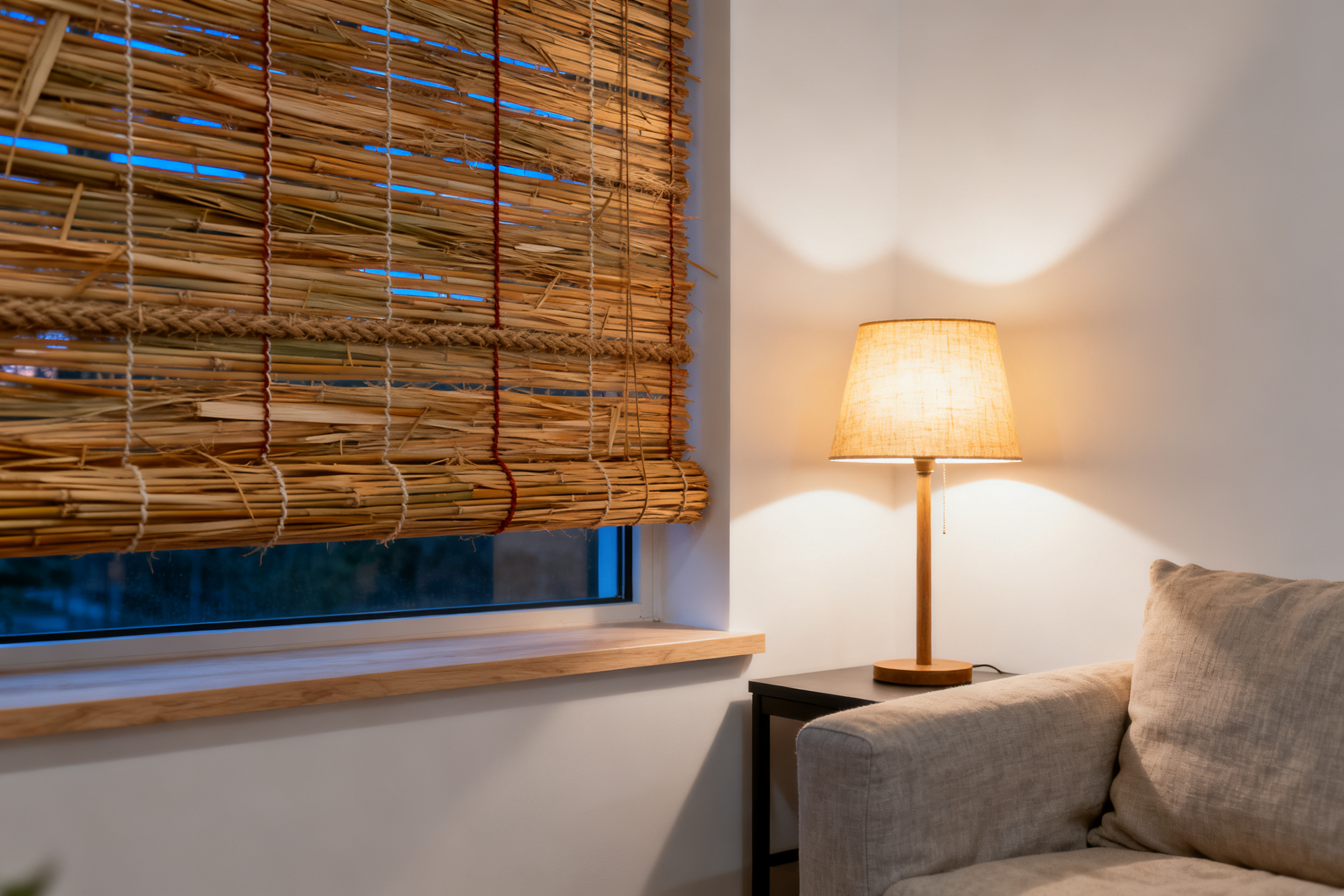
In the room

Unlined note: the brand states that unlined shades may cast slight shadows during the day
Catalogue photo from Two Pages, retrieved 2026-09-24.
It is ten at night, the lamp by the sofa is on, and someone walking past can see into your living room. Not all of it, because the bamboo shade is down. What they see is the shade lit from behind, every strand drawn in silhouette, and between the strands, the room. Two Pages puts it more politely: an unlined woven shade gives “maximum light and view through the selected fabric.”
Most advice on bamboo shades sorts them by fibre: bamboo, jute, ramie, something called natural. The two shops this site follows that sell woven wood shades sort them another way. Both sell you the darkness on a separate line, as a liner at a flat price. Both print a shading rate for the liner, and neither prints one for the bare weave, bar a single listing we will come to. The third shop, Half Price Drapes, sells no woven shade at all.
The listing that does not exist
| Half Price Drapes | halfpricedrapes.com sells no bamboo or woven wood shade. |
Checked 2026-09-24 against the full public collection list of each domain and each merchant’s own search. Nothing was missed on our side. There is nothing there.
This guide takes them in the order your window imposes: window, liner, fibre. If you are still weighing woven wood against every other family of window treatment, start there. If it is a fabric shade with the same folding action you are weighing it against, roman shades compared fold by fold covers that side.
Your window rules out options before any fibre does
Start with a tape measure. Three published numbers settle things no photo will.
The first is height. You can have the Rae Series D from Two Pages, a bamboo and jute shade, cordless up to 79 inches long. Past that, the configurator only accepts the corded lift, which goes to 179 inches, and the listing itself recommends the cord “for tall or obstructed windows.” On a tall window the lift is chosen for you, and a cord will hang beside the frame whatever you had in mind.
The second is depth, and here the listings go quiet. The only minimum depths published for a woven shade in this group are for motorised ones: 4 inches for the Smart Motorized Window Woven Bamboo Shades at Two Pages, 2 1/2 inches for a motorised Neutral Curtains shade. Neither shop prints a minimum for its manual bamboo shades. If you want the shade inside the frame, measure the reveal and ask before you order.
In the room

Stack height: minimum 7 in when fully raised
Catalogue photo from Neutral Curtains, retrieved 2026-09-24.
The third is the one people forget. A woven shade does not vanish when you raise it. Neutral Curtains gives a minimum stack of 7 inches for its bamboo shades fully raised, and adds that it varies with style, size and fabric. Inside the frame on a 60-inch drop, that is close to an eighth of the height, covered for good, at the top of the glass where the light comes in highest. Mount the same shade outside the frame and a few inches up, and those 7 inches sit on the wall instead.
Then the edges. On an inside mount, Neutral’s factory takes 3/8 inch off the width you order, and that fraction is daylight down the sides. Neutral is also the only shop here that lets you cancel it: leave a note on the order asking for no deduction. Its shades are handmade, and it allows about 0.4 inch of variation on the finished size, so the fit you get is close, never exact.
Between the window you measure and the size that gets made
| Listing | Taken off the width | Variance allowed after that |
|---|---|---|
| Neutral CurtainsCustom Bamboo Shades & Blinds – Alum. Headrail | 3/8 inThe factory takes it off | 0.4 in on the finished size |
| Neutral CurtainsWillow Bamboo Blinds & Shades | Wheat | 3/8 inThe factory takes it off | 0.4 in on the finished size |
2 of these 2 listings publish a width deduction, and 2 publish a variance on the finished size. The two are separate numbers and they run in the same direction. Nothing here is averaged, totalled or borrowed from a neighbouring listing.
Taken from the official Neutral Curtains, Two Pages product pages on 2026-09-12 and 2026-11-28. We measure nothing ourselves, so every percentage here is the figure the brand prints.
By day the weave is a texture. After dark, it is a window
In daylight you see a woven shade at its best. Outside is brighter than inside, so you read the strands as a surface and the gaps between them glow. Two Pages warns that its unlined shades “may cast slight shadows during the day,” which means the weave draws itself across the sill and the floorboards. It is the look the catalogue photos sell you.
In the room

Neutral Curtains states: 50% shading as published by the brand
Catalogue photo from Neutral Curtains, retrieved 2026-09-24.
After dark the ratio flips. Once you switch the lamp on, the room is the bright side, and every gap that let the sun in now lets the room out. Nothing about the weave has changed. Only the direction of the light has. Neutral Curtains describes its unlined bamboo shades from the same side of the glass as Two Pages: they “allow sunlight to pass through freely.” Neither prints a figure for the bare weave of these shades.
A measure worth keeping
two lighting conditions, one of them unlined
An unlined weave is a daytime filter
Judge a bare woven shade by what it does between breakfast and dusk, and treat everything after dusk as a separate question that only a liner answers.
A woven panel is strands with air between them. In daylight the bright side is outside, the strands read as a textured surface and the gaps glow, which is the look people buy it for. Once the lamps are on, the brighter side is the room, and every gap that let the sun in now lets the room out. Nothing about the weave changes; the direction of the light does. That is why the density of the weave is a question of texture and the liner is a question of use.
Measurable geometry rather than a product claim. Hold it against your own window before you trust it.
One listing in this group does rate its bare weave: Neutral’s Willow, in Wheat, at 50% shading. Hold on to that; what it is made of comes up below.
So the question you are really asking, can people see in at night, has no answer on the fibre side of the listing. The answer is further down the form.
The liner is sold in steps, and the steps do not follow the dark
That answer is a liner, sewn behind the weave. Both shops sell it as a short ladder, at a flat price that stays the same whatever size of shade you order.
Two Pages has three rungs, identical on both Rae Series D listings: unlined at no charge, a beige-white privacy liner it rates at 50 to 75% shading for $49.99, and a white blackout liner it rates at 96 to 100% for $69.99. Neutral has nine, and the rates come from the brand’s own liner guide for bamboo shades: four privacy liners at 60%, a khaki one at 75%, a heavy white 350 gsm one at 80%, and two blackouts rated 100%. They cost $52 to $99. The configurator also offers a tenth, a European flax liner at $82, which the guide does not rate.
Behind the weave: the liner ladder, step by step
Neutral Curtains
Custom Bamboo Shades & Blinds – Alum. Headrail
unlined
privacy
room darkening
blackout
On this ladder the price does not follow the darkness: White Belgian flax (60%) costs $99.00, more than Thermal blackout, 250 gsm coated (100%) at $72.00.
Two Pages
Rae Natural Ramie Jute Woven Wood Shades – Series D and Rae Top Down Bottom Up Woven Wood Shade Cordless – Series D
unlined
privacy
blackout
From the first liner to the darkest one, the step costs $20.00 more, at any size.
Each amount is a flat add-on on top of the shade, the same at every size. The rates are the ones each brand prints for its liners; none describes the bare weave, and the ladders are not ranked against each other.
Taken from the official Neutral Curtains, Two Pages product pages on 2026-11-28. We measure nothing ourselves, so every percentage here is the figure the brand prints.
Read the ladder by the rung, and ignore the price order. At Neutral the Belgian flax liner is rated 60% and costs $99. The thermal blackout is rated 100% and costs $72. Twenty-seven dollars more, to let more light in.
Easy to get wrong
| The habit | What it costs | Instead |
|---|---|---|
| Choosing the weave first and the liner last The collection is picked from the photos, and the liner is treated as a finishing option at the bottom of the order form. | The texture that sold the shade is the texture a liner flattens: from the room a lined weave still shows its strands, but it stops glowing, and from the street it shows the liner, not the fibre. The buyer ends up paying for a weave whose best feature the liner has switched off, or skips the liner and gets a lit screen at night. | Decide the liner first, from what the room does after dark. If the answer is a liner, choose the weave for how it reads lit from the front, not from behind. |
A habit that goes wrong, and what to do instead. Nothing on this card was taken from a listing.
A rung is easier to picture than a percentage, and the words on it are the brands’ own: what those light words mean moves from shop to shop. A 60% privacy liner gives you a dimmer room at noon, and still a daytime one. After dark it is the liner that faces the lamp, so the silhouette problem from the street goes, and what a passer-by sees is an evenly lit panel. That panel is the liner, not your fibre: white, beige, khaki or coffee in Neutral’s list, white or beige-white at Two Pages. From the sofa you still see the strands, but the glow has gone. You keep the texture and give up the backlight.

Read it on the merchant’s page
Neutral Curtains · Custom Bamboo Shades & Blinds – Alum. Headrail
Listed from $65.00
What that covers: lowest base price of the six collections on the listing (Natural 65.00, Nomi 79.00, Ivy 81.50, Ramie 98.50, Willow 102.00, Hazel 125.00). The page states the rule itself: Total Price = Base Price + Add-ons.
Build your size at Neutral CurtainsThis is an affiliate link: a commission may come back to us, you pay nothing extra for it, and Neutral Curtains charges the same either way. The number above was read on 2026-11-28, so treat the live listing as the figure that counts. That picture belongs to Neutral Curtains and was taken from the catalogue on 2026-09-24.
The fibre is in the listing, just not always in the name
Only now does the fibre get a vote, and the composition line is worth more than the title.
You will find the Rae Series D sold as Rae Natural Ramie Jute Woven Wood Shades. Its description says it is handwoven from bamboo and jute. You get ramie in the name and nowhere in the text. Nobody is hiding anything. Read the second line before the first.
The two listings

Composition: bamboo and natural jute fibres, handwoven

Composition: 20% bamboo, 80% paper
Taken from the official Neutral Curtains, Two Pages product pages on 2026-09-12 and 2026-11-28. We measure nothing ourselves, so every percentage here is the figure the brand prints.
The Willow is the sharper case. Neutral sells it as a bamboo shade, and its specification line reads 20% bamboo and 80% paper, at 405 gsm, with that 50% shading. The one woven shade in this group that rates its own bare weave is mostly paper. Pick it for the bamboo and you are buying a paper weave with some bamboo in it. That can be the right shade, as long as you choose it knowing.
On Neutral’s main bamboo listing you choose from six collections, Natural at $65 up to Hazel at $125, and the brand describes the fibre of only one: ramie, which it says is undyed and “tends to darken when exposed to sunlight.” On a shade you raise every morning, the folds in the stack stay in shade and the panel that hangs at noon does not. Over a few summers the two can drift apart in colour, the stack staying lighter.
The edge is the other place a natural fibre shows its nature. A cut edge of woven reed or jute can work loose, and Two Pages sells a fabric binding for $19.99 that it says “helps reduce the risk of natural fiber fraying.” On a shade that goes up and down every day, it is the one add-on that protects the texture you paid for.
A 36 by 60 inch window, priced, and what the liner adds to it
Listed prices here are floors, so here is one real window priced in each configurator: 36 inches wide, 60 long, inside mount, cordless, no liner.
At Two Pages you pay $375.98 for the Rae Series D. The listing says $129.99, but the page opens at $179.98, because the $49.99 cordless lift is already ticked; the rest is the size. Add the privacy liner and the total is $425.97. The blackout takes it to $445.97.
At Neutral, the Natural collection comes to $273.98: the $65 on the page, plus a line above the basket that reads “Selection will add $208.98 to the price,” with the cordless lift and the free back valance. With the 60% liner at 90 gsm it is $325.98, and with the thermal blackout $345.98.
The same window, priced listing by listing
One shade, 36 in wide by 60 in long, priced in each merchant’s own configurator with the same options at each step.
Neutral Curtains · one total
Two Pages · one total
2 totals read on screen, none of them calculated by us. They are ranked within a merchant and never across two: a total covers whatever steps that merchant folds into its own configurator, and those steps are not the same from one site to the next.
Taken from the official Neutral Curtains, Two Pages product pages on 2026-11-28. We measure nothing ourselves, so every percentage here is the figure the brand prints.
Those two totals do not belong on one scale. The collections differ, and so do the steps each configurator folds in. Inside each shop, though, the sums tell you something. At this size the blackout liner is 16% of the Two Pages total and 21% of the Neutral one. And at Neutral, where the size charge is the same on every collection, going from the cheapest fibre to the dearest costs $60 at any window, while going from no liner to blackout costs $72. Measured in dollars, the liner is as big a decision as the fibre.
Read it on the merchant’s page
Two Pages · Rae Natural Ramie Jute Woven Wood Shades – Series D
Listed from $129.99
What that covers: listed starting price, identical on all 15 colourways of Series D, no struck-through price. Size, lift and lining are billed on top in the configurator, so this is a floor.
Build your size at Two PagesThis is an affiliate link: a commission may come back to us, you pay nothing extra for it, and Two Pages charges the same either way. The number above was read on 2026-11-28, so treat the live listing as the figure that counts. Catalogue photography supplied by Two Pages, retrieved 2026-09-24.
Bamboo shades in three rooms, and where each one starts
If your window looks onto a garden and nobody looks back, you need no liner. The weave is the point, and daylight shows it best. Spend on the fibre you like, and if the window is taller than 79 inches at Two Pages, accept the cord.
If the room faces the street, you want the cheapest rung that gives privacy, with the difference spent on the weave: $49.99 at Two Pages, $52 at Neutral. Before you commit, try the sample the way the street will see it, at night, with the lamps on. The $99 flax liner buys the same published 60% as the $52 one, and I would not pay the difference on a shade whose face is bamboo.
Worth the twenty minutes
Tape the sample to the glass, then go outside after dark
Order the swatch with and without its liner, tape both to the inside of the window with the room lamps on, and look at them from the pavement or the garden at night.
Catalogue photos of woven shades are almost always taken against daylight, which is the one condition that flatters an open weave. The reading that decides a bedroom or a street-facing room is the other one: lit room, dark street. Two minutes outside with a lamp on inside tells you whether you need the liner, and which one, before the order is made to measure and cannot be returned.
A handling step rather than a selling point. It works the same whatever label is sewn into the panel.
In a bedroom you go to the blackout rung, $69.99 or $72, and then deal with the edges, because a liner does nothing about the gap at the sides. Mount the shade outside the frame, or at Neutral ask for the 3/8 inch deduction to be left off. If the room also faces a street, a top-down bottom-up version keeps the lower half covered while the light comes in over the top.
In the room

Mechanism: top-down bottom-up woven wood shade: the woven panel can be lowered from the top rail or raised from the bottom rail, cordless only
Catalogue photo from Two Pages, retrieved 2026-09-24.
If it were my street-facing living room, I would take the cheapest privacy liner on either site and put everything I saved into the weave I actually wanted to look at every evening.
Worth considering instead
One weave through the house, a different liner in each room
Use the same woven shade in every room that can be seen from the street, and change only the liner: none in the kitchen, a privacy layer in the living room, a dark one in the bedroom.
From outside, a row of windows reads as one facade, and matched shades make it read calm. From inside, each room gets the light it needs, because the liner is the part that decides light and it sits behind the weave where nobody sees it change. It also means one swatch decision instead of five, and the texture carries through the house the way a floor does.
A way of laying out what is already in the room, not a shopping list. Nothing new has to be ordered for it.
Common questions about bamboo shades
Can you see through bamboo shades at night? Unlined, yes: Two Pages says its unlined weave lets through “maximum light and view.” At night the lit room is the bright side. A privacy or blackout liner is the fix.
Can bamboo shades be blackout? With a blackout liner, rated 96 to 100% by Two Pages ($69.99) and 100% by Neutral ($72). The sides still leak unless you mount outside or cancel Neutral’s deduction.
What is the difference between bamboo and woven wood shades? At these shops, the mechanism is the same; the names overlap. Read the composition: the Rae lists bamboo and jute, and Neutral’s Willow bamboo shade is 80% paper. The other shade families do differ in mechanism.
Do woven wood shades work in a bathroom? Neutral files bamboo shades under bathroom and says they are fumigated against mould. It publishes no water resistance or humidity rating, and the Willow it sells there is 80% paper. More on a bathroom window.