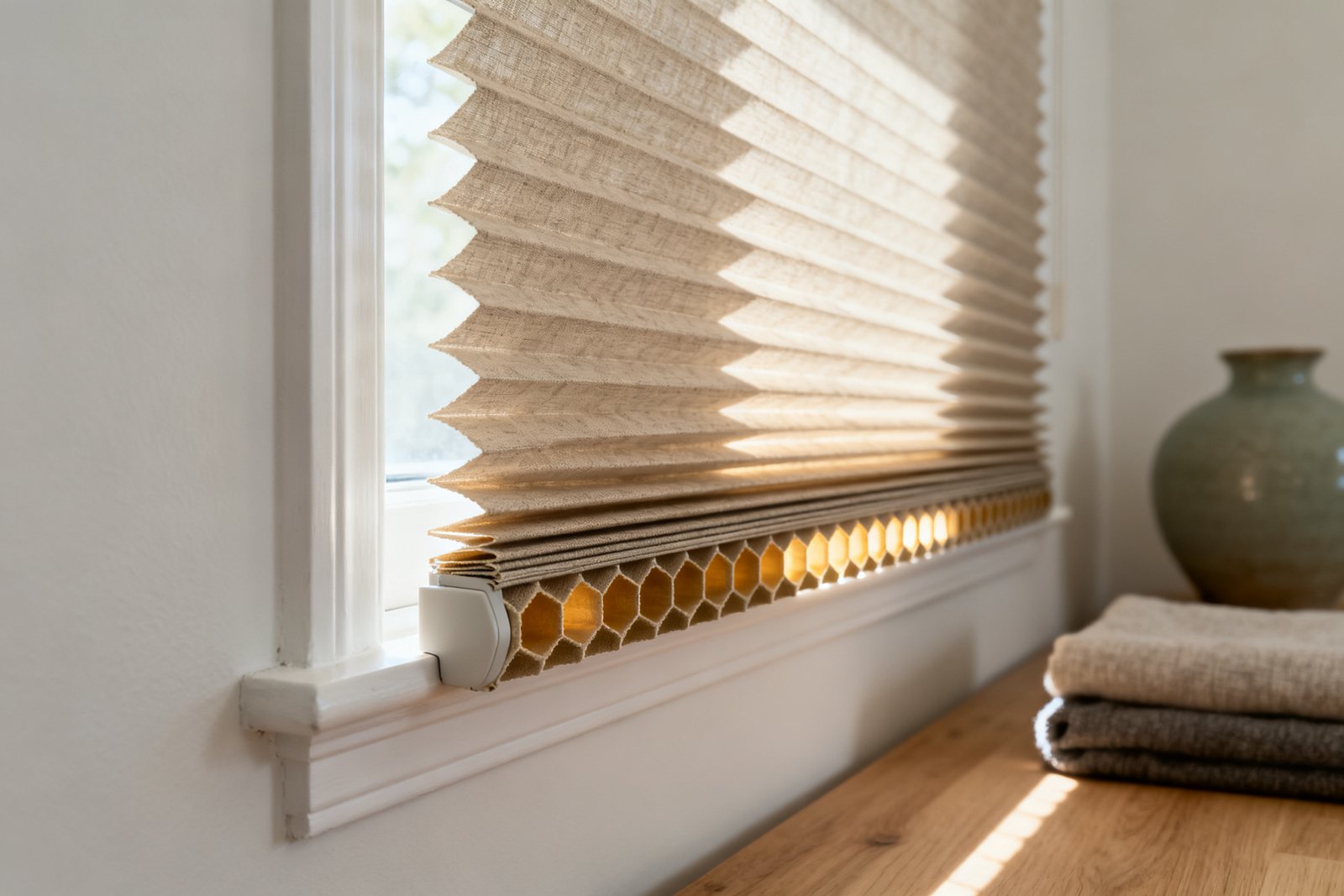
In the room

Listed at $68.99. listed starting price (7 colourways, all at 68.99, no compare_at). Size entered in the configurator.
Catalogue photo from Two Pages, retrieved 2026-09-19.
$68.99 at one end of the range, $118.99 at the other, and the cloth is identical on both: 100% polyester at 225 gsm, folded into honeycomb pleats of about an inch. Same merchant, same catalogue, same day.
Two Pages publishes six cellular listings and that is the whole of the category there, one fabric under six names. The other two merchants this site follows do not sell a cellular shade at all. Across the 687 products Neutral Curtains publishes, the word never appears. Across the 2,682 at Half Price Drapes, the only honeycomb in the building is a printed cotton sold by the yard.
The short answer, before the money: a cellular shade is cloth folded into hollow cells that collapse into one another when you raise it. It lives in the shades half of the window treatment map, next to rollers and romans. Once you want that, the cell is the one thing you have stopped choosing.
A cell is a pocket of air with cloth around it
The construction is published in three lines, the same three lines on every listing in the range. Polyester at 225 gsm. Pleats of approximately 1 inch, described as honeycomb. An aluminium coated interior, behind a front face in seven colours and a back that stays white on all of them.
Those 225 grams weigh the wall of the cell, not the shade. Folded, the same cloth gives an object roughly an inch deep hanging and almost nothing raised, because the cells close into each other instead of rolling onto a tube, which is what a roller shade does. That is why an aluminium headrail of 2 3/16 inches deep by 1 3/8 high can carry a shade covering a window 94 inches tall.
Give the white back a second before you pick a colour. You choose the front for your room, and the street gets white whatever you chose.
One cloth, six cellular listings, and fifty dollars between the ends
The range, floor price by floor price, from the merchant’s own collection page: $68.99 screwed, $82.99 for the one that also comes down from the top, $88.99 no-drill, $98.99 day-night, $102.99 no-drill top-down, $118.99 no-drill day-night. The same six numbers were there four weeks earlier, and not one carries a struck-through price.
One fabric, one merchant: what the mechanism costs
Two Pages · Aura Blackout Cellular Window Shades Cordless
100% Polyester · 225 gsm, 6 separate listings, 6 different floor prices
Each row is its own product page at that merchant, carrying the same fabric. The lowest bar is the figure you meet first. Prices are floor prices before size, lining and lift are chosen, so they are starting points, not what a finished shade costs. 6 listings read on the merchants’ own collection pages.
Taken from the official Two Pages product pages on 2026-09-19. We measure nothing ourselves, so every percentage here is the figure the brand prints.
Fifty dollars separates the two ends and none of it buys cloth. It buys a bracket that clamps instead of screwing, or a second rail, or a second layer. The fabric weight, the pleat size, the headrail and the size range are printed identically on all six pages.
Which leaves the entry price doing something awkward. The $68.99 you meet first belongs to the only mounting that needs a drill, so if you rent, yours sits twenty dollars further down the page.

Check it at the source
Two Pages · Aura Blackout Cellular Window Shades Cordless
Listed from $68.99
What that covers: listed starting price (7 colourways, all at 68.99, no compare_at). Size entered in the configurator.
Build your size at Two PagesAffiliate link. Fold & Light may earn a commission at no cost to you, and it does not change what Two Pages charges. The figure above is what the listing showed on 2026-09-19; the merchant’s own page is the price that counts. That picture belongs to Two Pages and was taken from the catalogue on 2026-09-19.
One more thing about the six: every one is sold as blackout. No light filtering cellular, no sheer cell, no daylight version.
Two and a quarter inches, or two, depending which half of the page you read
For an inside mount, the screwed listing asks for 2 inches of depth in its description and 2 1/4 inches in its own specifications block, further down the same page. Flush, the description says 2 1/4. The no-drill listing says 2 1/4 in both places. The day-night repeats the screwed one, two figures, one page.
Minimum window depth for an inside mount
Two Pages
2 1/4 in
Aura No-Drill Blackout Cellular Window Shades Cordless
Two Pages
2 in
Aura Blackout Cellular Window Shades Cordless
Two Pages
2 in
Aura Day Night Blackout Cellular Shades Cordless
Measure the reveal before choosing a fabric. A shallow frame rules options out faster than a budget does.
Taken from the official Two Pages product pages on 2026-09-19. We measure nothing ourselves, so every percentage here is the figure the brand prints.
A quarter of an inch sounds like pedantry until you hold a tape in a shallow reveal: it decides whether the shade sits in the frame or goes on the wall above it. Take the measurement in front of the glass. A window handle, a casement stay or a crank eats the depth before the shade gets any.
A cell is still the least demanding thing you can put in a shallow reveal: two and a quarter inches, against the 4 inches the same merchant asks for its motorised roller. If the reveal loses anyway, the outside mount wants 1 inch of flat trim above the opening.
Somebody has to take an eighth of an inch off, and the listing decides who
Now the number nobody reads. Each shade is made to the width you type, so something comes off the number you measured to leave clearance at the sides, and each listing names a different something.
Compare the two

Width deduction: 0.25 in

Width deduction: 0.125 in
Taken from the official Two Pages product pages on 2026-09-19. We measure nothing ourselves, so every percentage here is the figure the brand prints.
The screwed listing states it twice and differently: Inside Mount Order Width: Window casing width minus 1/4″ in the description, and Inside mount deduction by you: 3/8″ in the specifications block. The day-night says 1/4 in both places. The no-drill says Window Width minus 1/8″. All three hand the subtraction to you, and none of the three publishes a tolerance on the finished size.
Between the window you measure and the size that gets made
| Listing | Taken off the width | Variance allowed after that |
|---|---|---|
| Two PagesAura Blackout Cellular Window Shades Cordless | 1/4 inYou take it off yourself | not published |
| Two PagesAura Day Night Blackout Cellular Shades Cordless | 1/4 inPublished without saying who | not published |
| Two PagesAura No-Drill Blackout Cellular Window Shades Cordless | 1/8 inYou take it off yourself | not published |
3 of these 3 listings publish a width deduction, and 0 publish a variance on the finished size. The two are separate numbers and they run in the same direction. Nothing here is averaged, totalled or borrowed from a neighbouring listing.
Taken from the official Two Pages product pages on 2026-09-19. We measure nothing ourselves, so every percentage here is the figure the brand prints.
On a shade whose selling point is darkness, that subtraction is the light gap. Order at minus 3/8 where the factory wanted minus 1/8 and you have decided, without knowing it, on a quarter inch of daylight down each side of the window. At seven in the morning it lands on the wall as two bright vertical lines, and no fabric density closes them.
So read the deduction line on the listing you are buying. The same cloth at the same merchant gave three answers on the same day.
The proportion to work to
close the head first
A shade leaks at its head before it leaks through its cloth
Budget for the band at the top of the shade: the rail, the brackets that carry it, and the gap between the rail and the wall. Close that band before you pay for a denser cloth.
A roman shade is a rectangle of fabric that stops where the mechanism starts, and the mechanism has to stand off the wall far enough to let the fabric roll up behind it. That standoff is an open slot running the full width of the shade, sitting at eye height above the window. Daylight entering there lands on the ceiling and lights the whole room, which is why a room can fail a darkness test with a cloth that passes it. A valance across the front of the rail, or a shade mounted high on the wall rather than inside the reveal, closes the slot. A heavier cloth behind an open head changes nothing at all.
Trade convention and proportion, not something a merchant told us. A tape measure settles it faster than we can.
The listing that says “blocks light completely” also warns you about the gap
The no-drill page describes high density blackout fabric with an aluminium coated interior that “blocks light completely”. Six lines below, under a heading called Note, the same page says this: Due to the no-drill bracket design, a small side light gap may occur at the headrail on the bracket side. No dimension is given for it.
Both sentences are true, and the second is unusually honest. A shade leaks at its head before it leaks through its cloth, and a bracket that grips the frame has to sit somewhere in the opening: at the top, on one side, at eye height standing and directly above you in bed.
In the room

Listed at $88.99. listed starting price, identical on all 7 colourways, no compare_at. Size entered in the configurator.
Catalogue photo from Two Pages, retrieved 2026-09-19.
So the twenty dollars buys a mounting method and costs back a band of light the brand will not measure. The trade can still be the right one. Where a lease rules out a drill, a gap at one corner beats no shade at all, and nothing shrinks: the no-drill takes the same window, 18 to 98 inches wide and 16 to 94 tall.
The common misstep
| The habit | What it costs | Instead |
|---|---|---|
| Assuming you can clamp a shade you bought to be screwed Ordering the ordinary version of a made-to-measure shade and planning to fit it without screws later, or to buy the clamp brackets separately afterwards. | The clamp brackets are sold to fit one headrail profile and will not take another, so the shade arrives with a headrail nothing grips. At that point the choice is drilling after all, or reordering. | Decide before you pay. The no-drill route is a separate listing with its own size range and its own minimum depth, not an accessory you add to a finished shade. |
A habit that goes wrong, and what to do instead. Nothing on this card was taken from a listing.
Check it at the source
Two Pages · Aura No-Drill Blackout Cellular Window Shades Cordless
Listed from $88.99
What that covers: listed starting price, identical on all 7 colourways, no compare_at. Size entered in the configurator.
Build your size at Two PagesAffiliate link. Fold & Light may earn a commission at no cost to you, and it does not change what Two Pages charges. The figure above is what the listing showed on 2026-09-19; the merchant’s own page is the price that counts. The image above comes from the Two Pages listing, retrieved 2026-09-19.
The thing a cell is for is the thing nobody puts a number on
Ask what the cell is for and every answer comes back thermal. Two Pages says so on all three pages: an aluminium coated interior that reflects heat and UV, rooms kept cooler in summer and warmer in winter, and on the day-night listing, a honeycomb structure that “creates an insulating air pocket”. Those are the brand’s words, quoted, not confirmed.
In the room

Listed at $98.99. starting price, identical on all 7 colourways, no compare_at. Size entered in the configurator.
Catalogue photo from Two Pages, retrieved 2026-09-19.
What none of the three pages publishes is a number. No R-value, no percentage, no comparison. The noise claim arrives without a decibel, the blackout claim without the percentage the same merchant prints on its Boutique roller shade. The cell count is missing too: you get a pleat size, never how many walls of fabric it contains.
Which puts a buyer in an odd position: the property the category exists for is the one you cannot compare between two listings, and all six carry the same cloth anyway. So insulation is not a thing to shop on here. It is a thing you get, in an amount nobody will state.
The day-night is the exception, because its second layer is visible and you can plan with it. A sheer band at the top and a blackout band below keeps daylight on the ceiling and cuts the line of sight at head height, which on a street facing window is the whole argument. At $98.99 it sits thirty dollars above the plain version of the identical fabric, and the thirty dollars buys the layer.
Another way to do it
Pick the colour room by room, keep one face on the street
Choose the shade colour for each room from the inside, then check what the same shade shows on the outside. Many cell and honeycomb constructions finish white on the back whatever the room side is, and that is what lets you run a warm colour in the bedroom, a grey in the study and a white in the kitchen without the front of the house turning into a patchwork. Where the back is not uniform, either keep one colour across the windows that share a facade, or accept that the outside is now part of the choice.
A facade reads as a set. Anyone standing across the street sees the windows together, in one glance, and a different cloth in each opening registers as an accident long before it registers as a scheme. Inside, nobody ever sees two of those rooms at once. So the two sides of the same piece of fabric are choosing for two different audiences, and only one of them is you. It costs nothing to check which face the listing is showing you in its photographs, and it is the single decision that is impossible to undo once eight shades are hanging.
An arrangement, not a recommendation to buy anything. It works with whatever you already own.
So which one, on a real window
A window you can drill, in a room you want dark. Take the $68.99 listing and spend nothing further on the mechanism. Put the difference into an outside mount with real overlap at the sides: an inch of flat trim, and the gaps close.
A rented flat, or a frame you will not put a screw into. The $88.99 no-drill, knowing what it concedes at the headrail, and reading its own deduction line, minus 1/8, not the one on the listing next to it.
A street facing room you live in during the day. The $98.99 day-night, but only if you want the sheer band. It is the same 225 gsm cloth as the $68.99 shade with a layer added.
If it were my window and the wall could take a screw, I would screw it. The rest of the decision fits in three words, in this order: depth, deduction, mechanism. The cell is a given.
Common questions
What is a cellular shade made of? At the only one of the three merchants that sells them, 100% polyester at 225 gsm, folded into pleats of about an inch, with an aluminium coated interior.
How deep does my window need to be? The screwed listings publish 2 inches in the description and 2 1/4 in their own specifications block. The no-drill says 2 1/4 in both. Measure in front of the glass.
Do cellular shades really insulate? Two Pages claims an insulating air pocket and a heat reflecting interior. It publishes no R-value and no percentage on any of its six listings, and we measure nothing.
Are no-drill cellular shades as dark as the screwed version? Same cloth, same blackout claim. The no-drill listing warns on its own page that a small side light gap may appear at the headrail, on the bracket side.