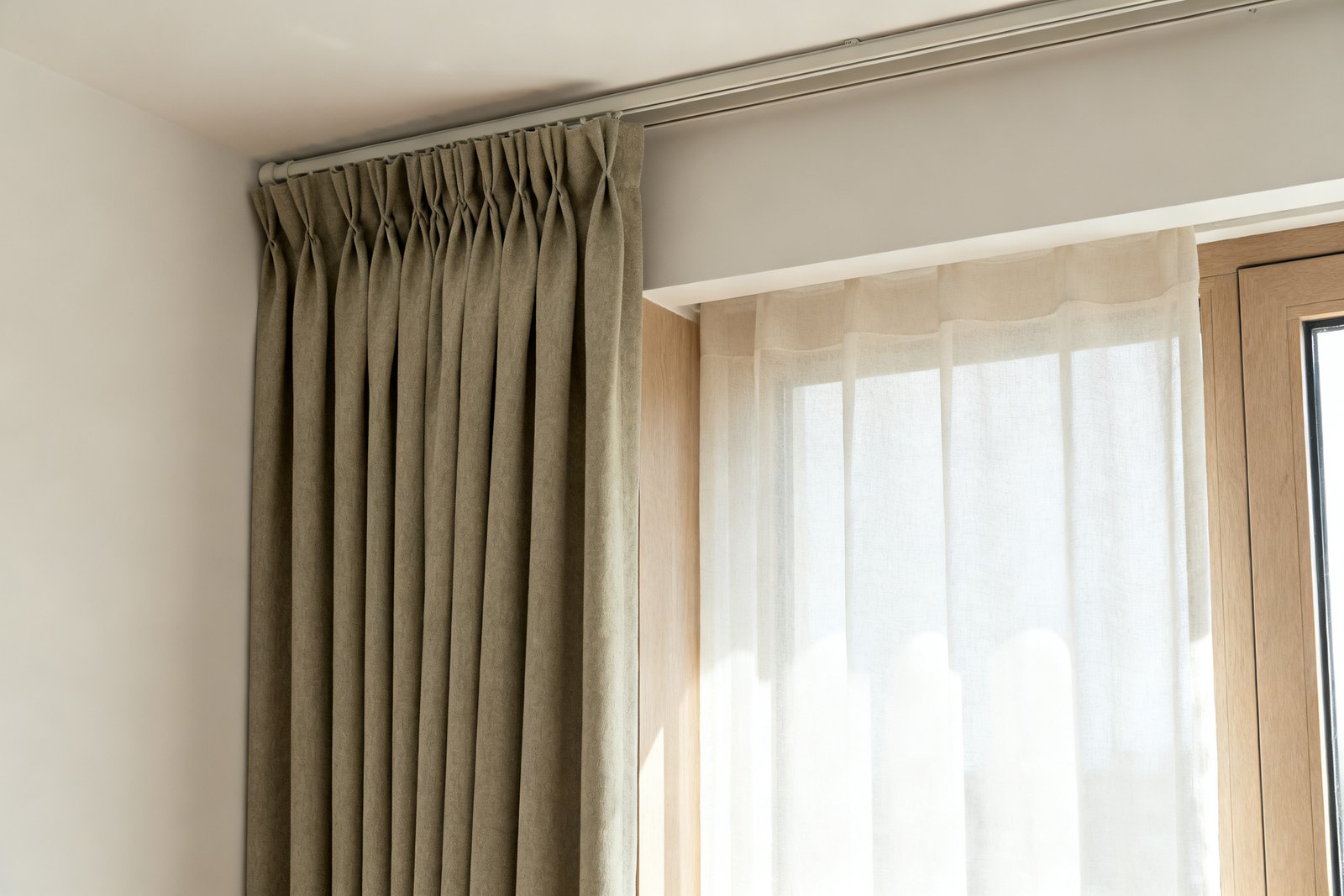
In the room

10% Linen, 90% Polyester · 350 gsm
Catalogue photo from Two Pages, retrieved 2026-09-11.
Most answers to drapes vs curtains are a dictionary rule. Drapes are lined, pleated and reach the floor; curtains are lighter, shorter, more casual. It is tidy, and the merchants selling both do not follow it.
Two Pages sells one cloth at 350 gsm and lists it as a Drape, as Curtains, and, on a third page, as a Curtain Pinch Pleated Drapery. Neutral Curtains prints both words on every panel in its range: Curtains & Drapes. Half Price Drapes, whose own name carries the word, calls its panels Curtains.
The noun on the listing is not a specification, then. But the thing you are picturing when you say drapes is real: heavier cloth, a deeper fold, a darker room, a more formal top. Those are three separate lines on an order form, and every merchant here sells them independently of the word in the title. This page reads them in the order that decides the look.
What the window asks for, before anyone names it
A window asks four things of a panel before any vocabulary is involved. Cover the opening. Close without a gap. Stack somewhere when it is open. Stop cleanly at the bottom. Only the last of those is published anywhere. Two Pages states a length tolerance of 1 inch on its panels, and Neutral Curtains states 0.4 inch on the finished size. Both figures land on the hem, which is the one line of a curtain the eye reads as either intended or missed. An inch of daylight under a panel does not look like a tolerance, it looks like the wrong size.
The first demand is where fixed sizes bite. The Half Price Drapes Signature Velvet is sold in a single 50 inch width, in lengths of 63, 84, 96, 108 and 120 inches. Width is not a choice there, so the question stops being what to buy and becomes how many: two panels give 100 inches of cloth, whatever the rod behind them measures. The trade convention is at least twice the rod width in cloth, and not one of these listings publishes a fullness ratio to check it against.
So whether a panel reads as a drape depends partly on how much cloth is gathered into it, and nobody selling one prints that number.
Drapes vs curtains, settled inside one catalogue
The clearest evidence sits inside a single catalogue. The Two Pages Liz fabric is 10% linen and 90% polyester at 350 gsm, and it appears as Liz Linen Drape Pleated, as Liz Linen Extra Wide Curtains Pleated, and as Liz Heavyweight Blackout Curtain Pinch Pleated Drapery, which manages both words in one title. The same merchant’s Isabella cotton, at 500 gsm, is a Drapery on one page and a Curtain on another.
Compare the two

10% Linen, 90% Polyester

10% Linen, 90% Polyester
Read off the Two Pages listings themselves, 2026-07-21 and 2026-09-02. None of these numbers is ours: where a percentage appears, it is the manufacturer claiming it.
Neutral Curtains resolves the problem by refusing to choose: its 250 gsm Belgian linen and its 285 gsm velvet are both sold as Curtains & Drapes. Half Price Drapes goes the other way and writes Curtain on everything, including the velvet panel it lines and calls Blackout.
What each brand calls it
Two Pages
- Liz Linen Drape Pleated
calls it: drape
10% Linen, 90% Polyester · 350 gsm - Liz Linen Extra Wide Curtains Pleated
calls it: curtain
350 gsm - Liz Heavyweight Blackout Curtain Pinch Pleated Drapery
calls it: curtain + drapery
10% Linen, 90% Polyester · 350 gsm · base panel - Isabella Heavyweight Cotton Drapery Pleated
calls it: drapery
500 gsm
Neutral Curtains
- 100% Belgian Flax Linen Curtains & Drapes Pleated
calls it: curtain + drape
100% Belgian linen · 250 gsm · base pleated panel, add-ons excluded (page states 'Total Price = Base Price + Add-ons'); compare_at 99.99 - Maillard Velvet Curtains & Drapes Pleated
calls it: curtain + drape
100% polyester velvet · 285 gsm · base price for a single panel, add-ons excluded (the page states 'Total Price = Base Price + Add-ons')
Half Price Drapes
- Earl Grey French Linen Room Darkening Curtain
calls it: curtain
100% Linen · weight not published · single ready-made panel; the listed figure already carries a standing '50% OFF' badge, a permanent anchor rather than a sale, and the real list price is unverified - Signature Velvet Blackout Curtain (Alabaster Beige)
calls it: curtain
100% Polyester velvet with an off-white thermal lining · weight not published · single panel, 50W x 84L (fixed size, width locked at 50 in)
Two Pages sells one fabric (10% Linen, 90% Polyester at 350 gsm) under drape and curtain + drapery.
3 listings carry more than one category word in a single title.
Read off the Half Price Drapes, Neutral Curtains, Two Pages listings themselves, 2026-07-21, 2026-08-20, 2026-08-21 and 2026-09-02. None of these numbers is ours: where a percentage appears, it is the manufacturer claiming it.
Read a title backwards and it becomes useful. The noun is there to be searched for; the words that tell you what arrives are the adjectives next to it: Heavyweight, Pinch Pleated, Extra Wide, Blackout. Those are real order lines, and the three that change what you see are below.
Weight is the lever the word is pretending to be
Four weights are published across this group: 250 gsm for the Neutral Belgian linen, 285 gsm for its velvet, 350 gsm for the Two Pages Liz, and 500 gsm for the Isabella cotton. Half Price Drapes publishes no weight at all for either of its panels.
Published weight, and what holds the cloth
None of these 6 listings publishes a fullness ratio, the multiple of track width that would tell you how deep the folds come out. 2 further listings show fabric on the face and publish neither a weight nor a make-up dimension: Half Price Drapes Earl Grey French Linen Room Darkening Curtain, Half Price Drapes Signature Velvet Blackout Curtain (Alabaster Beige). We are not estimating either.
Read off the Half Price Drapes, Neutral Curtains, Two Pages listings themselves, 2026-07-21, 2026-08-20, 2026-08-21 and 2026-09-02. None of these numbers is ours: where a percentage appears, it is the manufacturer claiming it.
The scale reads directly onto a window. Around 250 gsm a panel gathers into soft, shallow folds and lifts when a door opens across the room. Around 350 it has the mass to hang as a column, which is also what keeps the leading edges closed instead of drifting apart. At 500 gsm the fabric is no longer the question: a panel that heavy is carried by the bracket and the rod, and hardware sized for a light curtain will bow under it.
Compare the two

250 gsm

500 gsm
Read off the Neutral Curtains, Two Pages listings themselves, 2026-07-21 and 2026-09-02. None of these numbers is ours: where a percentage appears, it is the manufacturer claiming it.
Then the scale upends the fibre hierarchy most people arrive with. The heaviest linen-looking cloth in this group is the one with the least linen in it, at 10%. The genuine 100% Belgian linen sits 100 gsm lower, at 250, and the other 100% linen panel here publishes no weight at all. Buying linen to get a heavy fall is buying the fibre and hoping for the weight, which is the first thing to settle when you are choosing a curtain fabric.
Worth doing
Set the folds on the day you hang
Hang the panel, run your hand down each fold to set it front-and-back, then tie the whole curtain loosely at three heights and leave it two or three days.
New fabric has no memory. Left alone it dries into whatever shape it happened to fall in, and the folds stay uneven for the life of the curtain. Twenty minutes on day one is the difference between a curtain that hangs in even columns and one that never quite does.
Method, not merchandise. No part of this changes with where you bought the curtain.
Where this figure comes from
Two Pages · Liz Heavyweight Blackout Curtain Pinch Pleated Drapery
Listed from $59.99
What that covers: base panel
Build your size at Two PagesAffiliate link. Fold & Light may earn a commission at no cost to you, and it does not change what Two Pages charges. The figure above is what the listing showed on 2026-09-02; the merchant’s own page is the price that counts. The shot beside it is catalogue work by Two Pages, pulled 2026-09-11.
Lining is the second half of the look, and you pay for it by the line
Weight is not the only thing that makes a panel fall like a drape. A lining adds a second layer of cloth, and every merchant here treats it as an option rather than as part of what a drape is.
Neutral Curtains states that its base panel is non-blackout and sells the blackout lining as a paid add-on, on a listing that carries the word drapes in its title. Two Pages describes its Liz Heavyweight as blackout from heavy fabric plus a configurable blackout thermal lining, which is the same arrangement written as a spec. Half Price Drapes lines its velvet with an off-white thermal lining, calls the product Blackout, and states 90% blackout opacity on the same page.
Opacity, as each brand states it
Two Pages says
blackout from heavy fabric plus a configurable blackout thermal lining
Neutral Curtains says
non-blackout (base)
Neutral Curtains says
dark color shading effect of over 95 percent
Half Price Drapes says
room darkening (fabric)
Half Price Drapes says
90% blackout opacity
These are manufacturer claims, quoted as published. They are not measurements taken by this site, and the vocabulary is unregulated.
Read off the Half Price Drapes, Neutral Curtains, Two Pages listings themselves, 2026-07-21, 2026-08-20, 2026-08-21 and 2026-09-02. None of these numbers is ours: where a percentage appears, it is the manufacturer claiming it.
Two consequences follow, and they are not the same. On body, the lining does part of the job the weight does: it thickens the panel, so a mid-weight cloth hangs with the depth of fold people associate with the word drapes. On light, a claim of 90% from the brand is a level, not a state. It lowers what comes through; it does not change the hour. A south-facing room at midday under that panel is dimmer and still perfectly readable, which is worth knowing before you buy a word instead of a lining. Where the vocabulary itself comes from is the subject of blackout, room darkening and light filtering.
The same listing, twice

100% Polyester velvet with an off-white thermal lining

Half Price Drapes states: 90% blackout opacity
Read off the Half Price Drapes listings themselves, 2026-08-21. None of these numbers is ours: where a percentage appears, it is the manufacturer claiming it.
Neutral states a shading effect of over 95 percent, tied to its dark colours. Both figures belong to the brands that published them; we measure nothing here.
The header is the only lever you can see from the doorway
The third line on the order form is the top of the panel, the part a visitor actually sees. Half Price Drapes publishes three headers for its velvet panel: a pole pocket with hook belt, back tabs, and rings with drapery pins. Two Pages does something more revealing and names its panels after the header, so the same Liz cloth is sold Pleated, Grommet, Soft Top, Ripple Fold and Pinch Pleated.
Two views of one listing

100% Linen

100% Linen
Read off the Half Price Drapes listings themselves, 2026-08-20. None of these numbers is ours: where a percentage appears, it is the manufacturer claiming it.
Rule of thumb
The header chooses the hook
Pleated and taped headers (pinch, pencil, goblet) hang on hooks pushed into the tape; eyelet, tab-top and rod-pocket panels thread straight onto the rod and take no hooks at all. Rings carry either kind.
A hook only has something to grip when the top of the curtain carries a woven tape or a sewn pocket. On an eyelet or tab-top panel the rod passes through the fabric itself, so a hook has nowhere to sit. Reading the header first tells you in one look whether you are buying hooks, rings, both or neither, before you spend a penny on the wrong part.
Trade convention and proportion, not something a merchant told us. A tape measure settles it faster than we can.
A header decides the first few inches of the panel, and through them the whole read. A pinch pleat fixes the depth and spacing of the folds permanently in the sewing, so the panel keeps its shape whether it is open or closed. A grommet threads on the rod and produces one even wave, which reads as relaxed no matter how heavy the cloth behind it is. That is why the same 350 gsm fabric can look tailored on one listing and casual on the next at the same weight.
Another way to do it
Clip rings turn anything flat into a curtain
Clip-on rings bite onto the top edge of any flat panel, so a curtain with no header tape, a plain length of fabric, even a flat sheet, hangs as a curtain with nothing sewn.
The clip does the job the tape and hooks would have done, gripping the raw top edge instead of a stitched pocket. It is the fastest way to hang something that was never made to be a curtain, and the easiest heading to take down and wash, because nothing is fixed into the fabric.
An arrangement, not a recommendation to buy anything. It works with whatever you already own.
The same listing carries a limit that looks like a dimension and behaves like a style rule: the Half Price Drapes pole pocket takes a rod up to 1 1/2 inches in diameter. A thicker pole, the kind that makes a window look deliberately furnished, does not fit through it. Which rod carries which panel is a question of rods, rings and what carries the weight.
Where this usually goes wrong
| The habit | What it costs | Instead |
|---|---|---|
| Pinning through the front of the tape Pin hooks pushed straight through the face of the heading tape instead of into the woven pockets behind it. | The pins show on the front of the curtain and drag out under the weight of the fabric, dropping the panel one hook at a time. | Feel for the woven pockets on the back of the tape and slide each pin up inside one; the tape is built with them for exactly this. |
Common failure modes and their fix. No product data on this card.

Where this figure comes from
Half Price Drapes · Signature Velvet Blackout Curtain (Alabaster Beige)
Listed at $92.94
What that covers: single panel, 50W x 84L (fixed size, width locked at 50 in)
See the size options at Half Price DrapesAffiliate link. Fold & Light may earn a commission at no cost to you, and it does not change what Half Price Drapes charges. The figure above is what the listing showed on 2026-08-21; the merchant’s own page is the price that counts. The image above comes from the Half Price Drapes listing, retrieved 2026-09-11.
The number that is missing costs more than the word that is wrong
Half Price Drapes publishes no fabric weight for either the French linen panel or the velvet one. We are not estimating one. Of the three levers here, weight is the only one you cannot infer from the rest of a listing: the header is named, the lining is a priced option, and the number that predicts the fold is absent. On those two panels you buy the colour and take the drape on trust.
What these listings do not tell you
- Two Pages Liz Linen Drape Pleated: price, availability
- Two Pages Liz Linen Extra Wide Curtains Pleated: price, availability
- Two Pages Isabella Heavyweight Cotton Drapery Pleated: price, availability
- Half Price Drapes Earl Grey French Linen Room Darkening Curtain: weight gsm
- Half Price Drapes Signature Velvet Blackout Curtain (Alabaster Beige): weight gsm
Missing from the product page, so missing here too. A brand that prints the number is doing you a favour worth counting.
Read off the Half Price Drapes, Neutral Curtains, Two Pages listings themselves, 2026-07-21, 2026-08-20, 2026-08-21 and 2026-09-02. None of these numbers is ours: where a percentage appears, it is the manufacturer claiming it.
Prices do not rescue the comparison either. The Two Pages Liz Heavyweight starts at $59.99 for a base panel before size and options, and the Neutral Belgian linen at $89.99 on a page stating that the total is the base price plus add-ons. The Half Price Drapes velvet is $92.94 for a finished panel of 50 by 84 inches, and its French linen shows $99.96 under a standing 50% OFF badge, a permanent anchor rather than a sale.
Two floors and two finished articles, in other words. Ranking them compares a starting point with a delivered product, which is what a made-to-measure listing invites you to do by accident.
Three ways to order the look you actually mean
The word is a dead end, so here is the order form instead.
If you want the formal column. Start at the weight and take 350 gsm or more. Add a pleated header, which sets the fold permanently, and a lining for body rather than for darkness. The noun on the listing is irrelevant; three of the panels here would do it, and two of them are called curtains.
If you want light and air. Stay near 250 gsm, skip the lining, and hang on rings or grommets so the cloth can move. This is the panel most people mean by curtains, and it is also sold as drapes by two of these three merchants.
If you want the room dark. Buy the lining, not the word. Ask for the figure the brand itself publishes, since 90% and blackout appear in the same sentence on the same listing here. What that leaves you with at midday is a level, not a light switch, and it is one of several ways a window changes a room. And if the real question is drapes vs curtains vs blinds, the families sit side by side in the full category map.
Questions people ask before ordering
What is the difference between drapes and curtains? On these eight listings, none. Two Pages sells the same 350 gsm cloth under both words. What changes the panel is the weight, the lining and the header.
Are drapes always lined? No. Neutral states that its base panel is non-blackout and sells the lining as a paid add-on, on a listing whose own title says drapes.
Are drapes heavier than curtains? Not by definition. Published weights here run from 250 to 500 gsm without following the noun, and two of the eight panels publish no weight at all.
Should I buy drapes or curtains for a bedroom? Ask about opacity instead. Half Price Drapes states 90% on a panel it calls Blackout, so the lining decides the darkness, not the word.