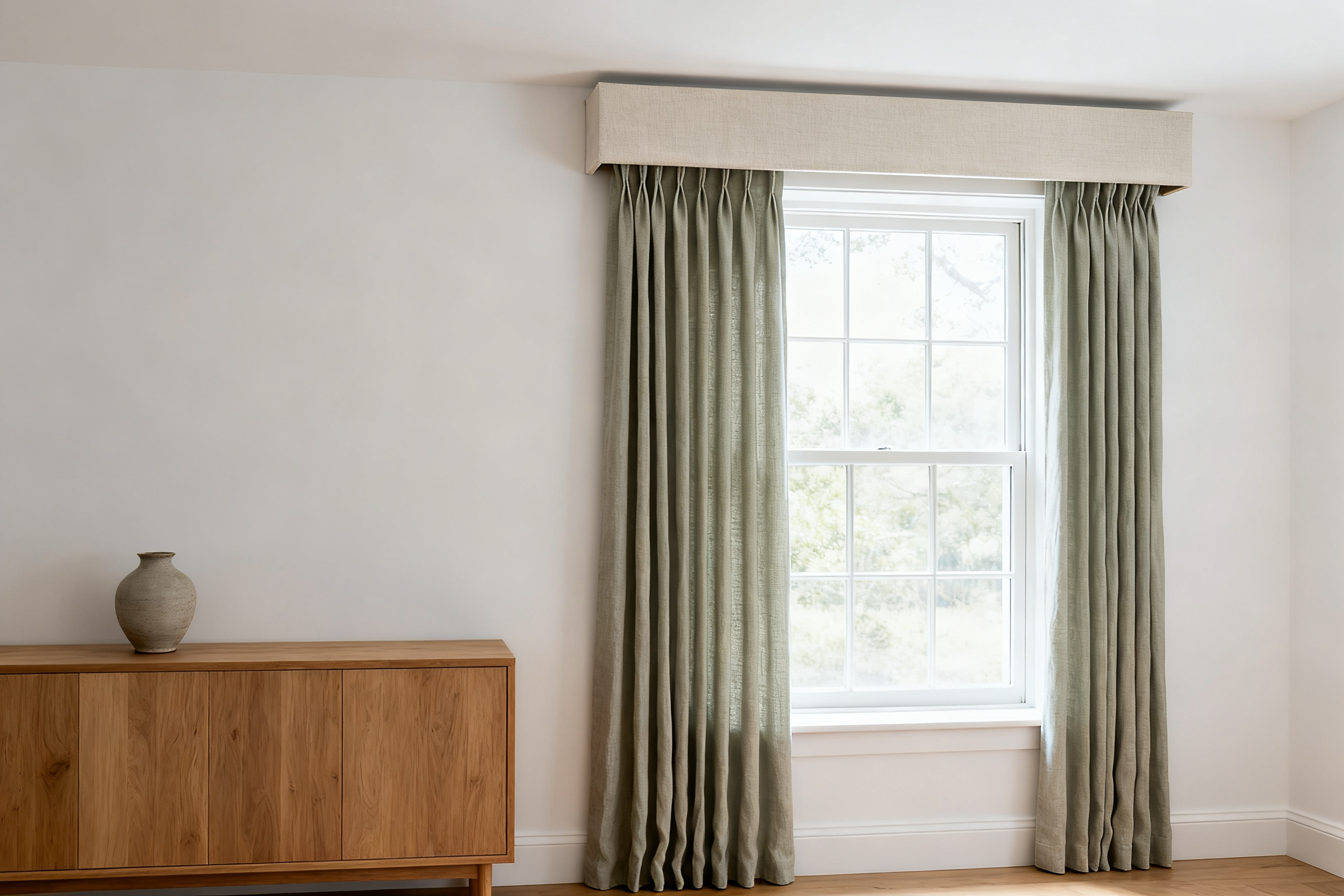
In the room

Listed at $149.00. starting price before size and return depth are chosen, on 25 of the 38 colourways (the other 13 start at $159.00), with no crossed-out price
Catalogue photo from Two Pages, retrieved 2026-09-24.
Two listings from the same merchant, cut from the same Liz fabric. The tailored valance says $89. The flat cornice board says $149. Sixty dollars apart, which sounds about right for a stiffer board.
Now order both for the same ordinary window, 52 inches wide and 12 inches tall. The configurator comes back with $229 and $425. The gap is $196, and neither listing warned you.
The three words first, because everything after depends on them. Valances and cornices do the same job, covering the top of a window: a valance with a short band of soft fabric, a cornice with a board covered in fabric and a hard lower edge. A swag is fabric hung in a curve with tails at the sides, and of the three merchants we follow, the only one that sells a swag sews it onto a board. All three sit above whatever else is on the window; the wider map of window treatments covers what goes beneath.
Two price tags, and two different rulers behind them
Both listings are made to order, so $89 and $149 are only where the configurator starts. What turns them into a price is the size, and the two listings measure it with different rulers.
The same window, priced listing by listing
One valance or cornice, 52 in wide by 12 in high, priced in each merchant’s own configurator with the same options at each step.
Two Pages · 4 totals, $346.00 between the lowest and the highest
4 totals read on screen, none of them calculated by us. They are ranked within a merchant and never across two: a total covers whatever steps that merchant folds into its own configurator, and those steps are not the same from one site to the next.
Source: official product pages from Two Pages, checked 2026-11-28. Fold & Light does not measure products; any percentage is the one that brand publishes.
On the valance, width adds $80 at 24 inches, then one dollar for every inch up to 60. On the cornice, a 52 inch board falls in a band that starts at $220 and climbs $7 an inch. Height follows the same pattern, cheaper on the soft side. By the time you reach a real window, the $60 on the tags has become $196, more than three times what they suggested.
Why 52 by 12? Because it is what Two Pages’ own measuring page would have you order for a window 48 inches wide: at least two inches past the frame on each side, and a height between a fifth and a third of the window. Twelve inches suits a window from 36 to 60 inches tall, which is most windows in most houses, and at that proportion the band reads as the top of the window rather than as a trim strip or a second curtain. This is the ordinary case, and on it the listing price is well under half of what you pay.
The real line is soft against stiff, and the titles do not draw it
Two Pages sells the category in twelve styles, all built on the same wooden mounting board, about half an inch thick. Its own definition is the textbook one: a valance is soft fabric, often pleated or scalloped, and a cornice is a structured board covered in fabric.
The configurator draws the line somewhere else.
The two listings

Size envelope: made to order; width 24 to 200 in, height 8 to 24 in, fractions accepted

Size envelope: made to order; width 24 to 76 in, height 8 to 30 in
Source: official product pages from Two Pages, checked 2026-11-28. Fold & Light does not measure products; any percentage is the one that brand publishes.
Six styles, from the tailored valance to the swagged Sheffield, can be ordered up to 200 inches wide. The other six stop at 76. Type a wider figure and the box answers that the width must be between 24 and 76. Those six are the four cornice boards and the two Roman valances, and they also carry the steep size scale and the dearer return. The Hobbled Roman Valance is a valance in every word of its title and a cornice on every line of its price.
One fabric, one merchant: what the style costs
Two Pages · Liz Linen, twelve valance and cornice listings
10% Linen, 90% Polyester · 350 gsm, 12 separate listings, 8 different floor prices
Each row is its own product page at that merchant, carrying the same fabric. The lowest bar is the figure you meet first. Prices are floor prices before size and return depth are chosen, so they are starting points, not what a finished valance or cornice costs. 12 listings read on the merchants’ own collection pages.
Source: official product pages from Two Pages, checked 2026-11-28. Fold & Light does not measure products; any percentage is the one that brand publishes.
Two Pages does not say why the stiff styles stop at 76 inches. What you can say is what the limit does to a room. A sliding door 96 inches wide, or two windows you would like under one band, has no rigid option at this merchant. You will be choosing among the soft styles, and a board with a dead-straight lower edge, which is the whole point of a cornice, is off the table.

Straight from the listing
Two Pages · Liz Linen Flat Cornice Board
Listed from $149.00
What that covers: starting price before size and return depth are chosen, on 25 of the 38 colourways (the other 13 start at $159.00), with no crossed-out price
Build your size at Two PagesThis is an affiliate link: a commission may come back to us, you pay nothing extra for it, and Two Pages charges the same either way. The number above was read on 2026-11-28, so treat the live listing as the figure that counts. Photograph from the Two Pages catalogue, retrieved 2026-09-24.
The return is priced by whatever hangs underneath
The return is the side of the valance, the short piece that turns back to meet the wall. It decides whether whatever is underneath gets hidden or just gets a fabric front.
In the room

Listed at $89.00. starting price before size and return depth are chosen, the same on all 38 colourways, with no crossed-out price
Catalogue photo from Two Pages, retrieved 2026-09-24.
Two Pages sells five depths, from 2 to 6 inches, and its measuring page gives the rule plainly: if the treatment underneath projects 4 inches from the wall, choose a return greater than 4 inches. So the first thing you measure is the thing you already own.
Over a roman shade mounted outside the frame, you have to clear the bracket. Two Pages publishes 2 3/8 inches for the bracket on its Liz shade, which puts it inside the 3 inch return, and the 3 inch return is included. The flat cornice stays at $425.
Over curtains, the figure moves, because it depends on how far the rod or track stands off the wall. The merchant’s ripple fold track stands 3 1/2 inches off it, which already rules out both free depths. And the curtain hangs in front of its track: a ripple fold swings to both sides of the carrier line, 4 to 4 1/4 inches deep in total, so its front sits about half a wave ahead, around 5 1/2 inches from the wall. That is our arithmetic, and no listing publishes it. It points to the 6 inch return.
The proportion to work to
deeper than the deepest thing below
The return has to reach past the front of whatever hangs below
Measure from the wall to the front face of the deepest thing under the valance or cornice, whether a shade bracket, a rod, a finial or the front of the folds, and order a return deeper than that figure.
The return is the side of the top treatment, the part that turns back to the wall. If it stops short, the ends of the rod poke out past it, the brackets show from the side, and on a curtain the folds rub against the lower edge every time it is drawn. A pleated or wave curtain sits in front of its own rod, so the figure to beat is the front of the fabric, not the rod.
Measurable geometry rather than a product claim. Hold it against your own window before you trust it.
Now the prices. On the soft valance, the 6 inch return adds $50, and the 52 by 12 comes to $279. On the cornice it adds $150, and the same board comes to $575. The plainest cornice and the most decorated one start $40 apart and share a size scale, so they stay $40 apart at any size. On a cornice, then, having curtains underneath costs more than any style you could choose on top.
Straight from the listing
Two Pages · Liz Linen Board Mounted Tailored Valance
Listed from $89.00
What that covers: starting price before size and return depth are chosen, the same on all 38 colourways, with no crossed-out price
Build your size at Two PagesThis is an affiliate link: a commission may come back to us, you pay nothing extra for it, and Two Pages charges the same either way. The number above was read on 2026-11-28, so treat the live listing as the figure that counts. Photograph from the Two Pages catalogue, retrieved 2026-09-24.
How tall it should be, and where it goes on the wall
The height rule on Two Pages’ measuring page is a standard trade proportion: about a fifth to a third of the window height. A 60 inch window takes 12 to 20 inches.
Easy to get wrong
| The habit | What it costs | Instead |
|---|---|---|
| Hanging the valance on the frame The valance or cornice is fixed at the top of the window frame, because that is where the window starts. | Its whole drop hangs over the glass, so the window loses its top strip of daylight and looks shorter than it is. A twelve inch valance fixed at the frame takes twelve inches of view. | Fix the board high enough that the lower edge lands at the top of the frame or just over it. The valance then covers wall and hardware, and the glass stays whole. |
Where this usually breaks down, and the correction. No product figures are involved.
The same page puts a standalone valance 4 to 6 inches above the frame, the same four to six inches a curtain rod usually gets, and the reason is the glass. Screwed at the top of the frame, a 12 inch valance hangs 12 inches over the window. Lifted until its lower edge meets the frame, it covers wall and hardware and nothing else, and the window reads taller than it is.
In the room

Listed at $49.99. ready-made price for one valance, 50 x 19 in, with no discount shown beside it
Catalogue photo from Half Price Drapes, retrieved 2026-09-24.
Half Price Drapes sells its valances ready made, in printed cotton, in a single size of 50 by 19 inches. They hang from a rod, through a pocket that takes a pole up to 1 1/2 inches across, or from back tabs or a hook belt. By the fifth-to-a-third rule, 19 inches belongs on a window between 57 and 95 inches tall. Over a 36 inch kitchen window it would come more than halfway down the glass.
Width is the one place Two Pages contradicts itself. The measuring page says at least 2 inches past each side, and the FAQ on its cornice listing says 4 to 6. If curtains open underneath, take the wider figure: they stack at the sides, and you want the valance to cover the top of the stack. Then measure it the way you would anything mounted outside the frame, from the wall and not from the glass.
Another way to do it
Tape the outline on the wall before you order
For anything mounted outside the frame, mark the finished rectangle on the wall with low-tack painter's tape, at the height and width you are about to order, and leave it up for a day.
An outside mount is not a window measurement, it is a coverage decision, and a number typed into a box gives you no idea what it will look like. Taped on the wall it takes thirty seconds to see that the width is mean at the edges, or that the header sits too low to lift the window, while the order can still be changed. It also shows you what the covering will hide: a light switch, a trim detail, the top of a radiator.
An arrangement, not a recommendation to buy anything. It works with whatever you already own.
Over a shade, it has an actual job
On most windows a valance is decoration. Over a shade it does something.
In the room

Listed at $89.00. starting price before size and return depth are chosen, the same on all 38 colourways, with no crossed-out price
Catalogue photo from Two Pages, retrieved 2026-09-24.
A raised shade does not vanish. It leaves its headrail, 2 3/4 inches tall on the Liz roman shade, and the stack of folds a roman shade makes when it is raised, right across the top of the glass. Two Pages does not publish how tall that bundle is on this shade, and we are not estimating it.
Neutral Curtains publishes it for its bamboo shades: at least 7 inches once the shade is fully up. It is also the only place the word valance turns up in its catalogue of 689 listings, as a 6 inch front valance that the motorized bamboo shade offers for $5. A 6 inch band over a 7 inch stack hides the headrail and leaves at least an inch of folds showing whenever the shade is raised.
Another way to do it
Let the valance hide the raised shade
Over a fabric or woven shade, order a valance a little taller than the stack the shade makes when it is fully raised, and fix it so its lower edge sits just below where the stack ends.
A raised shade never disappears: it leaves a bundle of folds and a headrail across the top of the window. A valance sized to that bundle turns it into a finished band of fabric, so the shade looks the same up or down and the window reads as fully open when it is up. It is the one layering where the top treatment does a job instead of only decorating.
An arrangement, not a recommendation to buy anything. It works with whatever you already own.
So when you layer, measure the stack before you size the valance, and make the valance the taller of the two. This is also the one layering where the return comes free, since a shade bracket sits inside the included depths.
The swag, and where it went
The listing that does not exist
| Two Pages | twopagescurtains.com sells no swag that is draped over a pole. |
| Half Price Drapes | halfpricedrapes.com sells no cornice board and no swag. |
| Neutral Curtains | neutralcurtains.com sells no valance, no cornice board and no swag as a product. |
Source: every public collection listing on each domain, plus each site’s own product search, read 2026-09-24. An absence is a finding here, not an omission: we looked, and there was nothing to find.
Nobody we follow sells a swag you drape yourself. Across 5,108 listings on the three sites, the word turns up in one place: Two Pages’ Sheffield valance, described as a scalloped hem with overlaid pleated pelmets, center swags and flared side tails, all held on the board.
In the room

Listed at $139.00. starting price before size and return depth are chosen, the same on all 38 colourways, with no crossed-out price
Catalogue photo from Two Pages, retrieved 2026-09-24.
That changes the object more than the name. A draped swag keeps its curves only until something knocks them. A swag sewn to a board keeps them because they are stitched. The Sheffield prices like the other soft styles, $139 to start and up to 200 inches wide, and it is the only soft valance you can order 30 inches tall, where the others stop at 24. The tails are the reason: they fall below the band. Count them when you apply the fifth-to-a-third rule, or the swag ends up on the glass.
If I were ordering one
Three windows, three answers.
- A shade mounted outside the frame, window under 76 inches wide. A tailored valance with the included 3 inch return, $229 at 52 by 12. If you want the hard edge, the flat cornice clears the same bracket for $425, still with no depth surcharge.
- Curtains on a rod or a track underneath. A soft valance with the 6 inch return, $279. Not the cornice at $575, and past 76 inches not a cornice at all. It is the classic top treatment over panels, and the depth is where it usually goes wrong.
- A rod already on the wall and nowhere you want to screw a board. The Half Price Drapes valance slides straight onto it, provided the rod is no thicker than 1 1/2 inches and the window is at least 57 inches tall. Its $49.99 buys one fixed size, ready made, and it does not compare with either total above.
If it were my window, with curtains already on it, I would order the soft valance with the 6 inch return. The depth is the part that has to be right, and on the soft side it costs $50 instead of $150.
Common questions about valances and cornices
What is the difference between a valance and a cornice? A valance is soft fabric, a cornice is a board covered in fabric. At Two Pages the stiff styles also stop at 76 inches wide and charge more for depth.
How deep should the return be? Deeper than whatever hangs underneath. A shade bracket at 2 3/8 inches needs the 3 inch return; a curtain track at 3 1/2 inches, with its folds in front, needs 6.
How tall should a valance be? Two Pages advises about a fifth to a third of the window height, fixed so the lower edge meets the top of the frame rather than the glass.
Can you still buy a swag? Not a draped one, from any of the three merchants we follow. The only swag on sale is the Sheffield valance, with its swags and tails sewn onto a board.