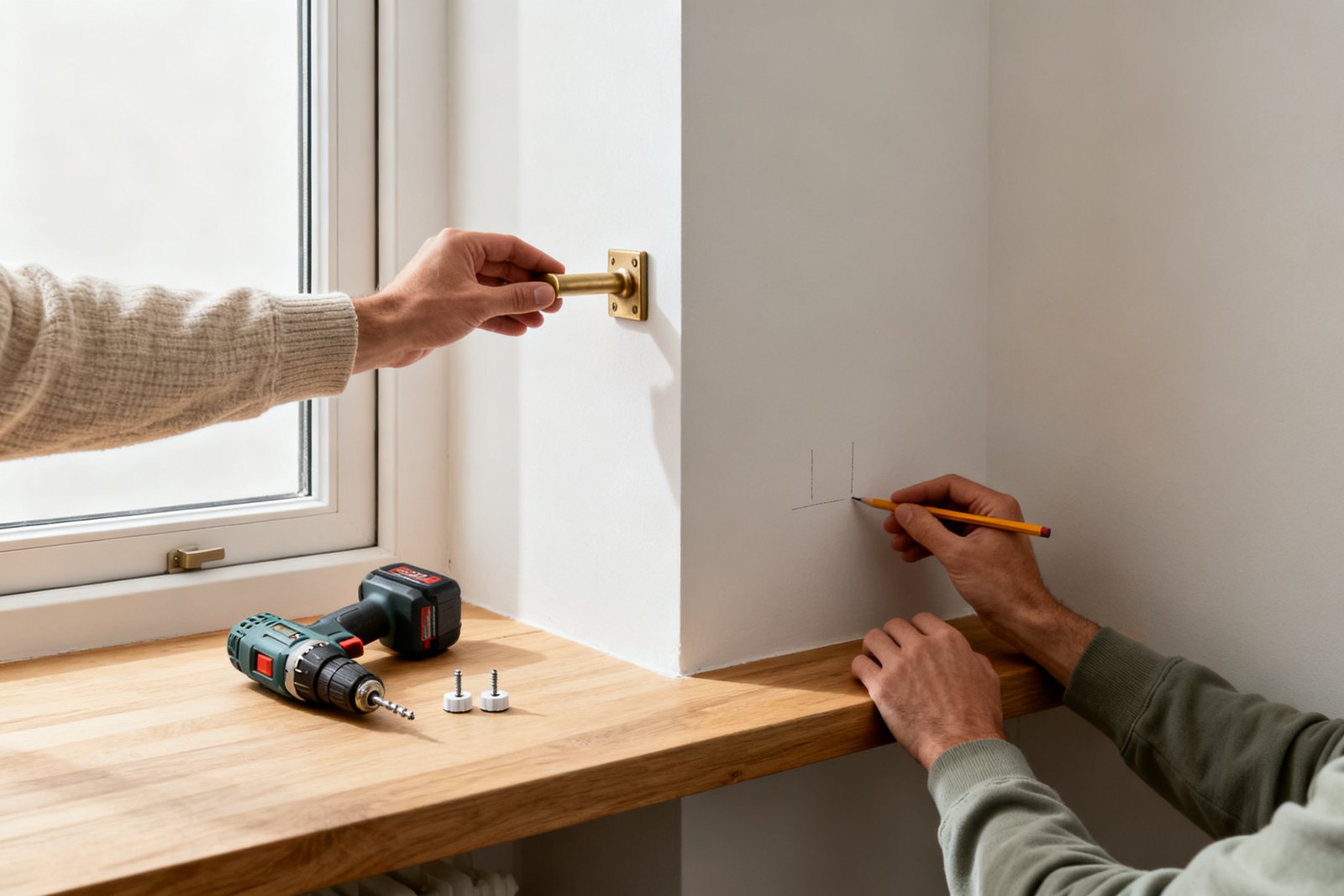
Most curtain rods that sag, tilt, or tear out of the wall did not fail because of a cheap rod or a blunt drill bit. They failed because the brackets went into plasterboard with nothing solid behind them. The rod is the easy part. What actually holds it up is decided before you drill the first hole, by two things almost nobody checks: what is behind the plaster, and how much the finished curtain is going to weigh.
So this is less a guide to a rod than a guide to a wall. The market will happily sell you a single rod that extends across a twelve-foot window and leave the hard part, the part that decides whether it stays up, entirely to you. Get the wall and the weight right and a modest rod holds for years. Get them wrong and the best rod on the market pulls a lump of plaster out with it the first winter you draw heavy curtains twice a day.
Start with the wall, not the window
Before the height, before the brackets, find out what you are drilling into. Behind the plaster is one of four things: a timber or metal stud, plasterboard with a hollow void behind it, plaster on lath in an older home, or brick and concrete. Each one grips a screw completely differently, and you cannot tell which is which by looking at the paint.
Run a stud finder across the wall at roughly the height the rod will sit, and mark where the solid points fall. Do this first, because the studs decide where the brackets can go, and the brackets decide everything downstream. Mark the height first, drill, and find a hollow void behind the plaster, and you are into a second set of holes or asking a wall plug to do a stud’s job.
Worth doing
Find the stud before you mark the height
Run a stud finder across the wall at rod height first, mark the solid points, then set the bracket positions around what will actually hold, not the other way round.
Where the bracket goes looks like a decision about the window, but the wall makes it. Mark the height first and discover there is nothing behind the plaster and you are left drilling a second set of holes or asking an anchor to do a stud's job. Two minutes with a stud finder is the difference between drilling once and drilling twice.
Mark both brackets off one level line
Set the height on one side, carry a spirit level or a laser line straight across to the other, and mark the second bracket off that line, not off the top of the window frame.
Window frames are rarely dead level, and a rod hung parallel to a frame that leans shows every degree of the lean once a curtain hangs off it. A rod set to true level reads straight even above a crooked window, because the eye trusts the curtain line over the frame.
A practical step, not a product claim. Nothing here depends on which brand you buy.
If you have not bought the rod and brackets yet, or you are not sure what the set should include, that is a separate decision, and we treat it in what rod and brackets you actually need. This page assumes the hardware is already in your hands, and the only question left is how to get it on the wall so it stays there.
The three measurements you settle before you drill
Three numbers get decided in pencil before a single hole is drilled. None of them is a product spec; all three are geometry you can check with a tape and a spirit level.
The first is height: four to six inches above the frame is the common convention, higher if you want the window to read taller. Where to hang it for looks is its own decision, covered in how high to hang the rod. The second is projection, how far the bracket holds the rod off the wall, set to clear whatever sits below it. The third is level: mark both brackets off one level line, not the top of the frame, because frames are rarely straight and a rod hung parallel to a leaning frame leans with it.
How a rod actually hangs
- 1Height above the frameFour to six inches above the frame, or higher to lift the window.
- 2Projection off the wallEnough to clear the sill, a radiator or a handle, plus the fabric.
- 3One level lineMark both brackets off a single level line, not the top of the frame.
- 4The fixingThe screw reaches a stud, or an anchor rated above the loaded weight.
Geometry and trade convention, not a product spec. Your wall and your tape set the numbers.
Measuring the rod path itself, rather than the window it covers, is a job in its own right, and how to measure the rod path walks through it. On the wall, that single level line is the whole trick: the eye reads the curtain, and a straight curtain quietly forgives a crooked window.
Match the fixing to the weight it carries
Here is the number nobody weighs. A bracket does not carry a rod. It carries the rod plus the curtain plus any lining, and it carries all of it under a firm tug twice a day for years. That load, not the rod, decides the fixing.
Rule of thumb
anchor → stud, by load
Match the fixing to the weight, not to the rod
Light voiles into a rated drywall anchor, everyday panels into an anchor rated well above the loaded weight, heavy or wide curtains into a wall stud or a masonry plug.
The load a bracket carries is the rod plus the curtain plus any lining, pulled twice a day for years. A bare screw in plasterboard holds almost none of it; a rated anchor holds a light to medium panel; only a stud or a masonry fixing holds a lined blackout, a velvet drape or a long rod without working loose. The weight sets the fixing, so weigh the curtain in your head before you choose the screw.
Geometry and long-standing trade practice, not a brand claim. Check it with a tape measure, not with us.
The catch is that the listing will not do this sum for you. Half Price Drapes sells its Glass Sphere set as a single telescoping rod that expands from 52 to 144 inches, wide enough for a twelve-foot sliding door, and it publishes no weight capacity at all. Two Pages, on its motorised curtain track, prints a figure: 110 pounds on a solid wall. So the number that would tell you what a fixing must hold exists in this category, but it turns up on a powered track, not on the plain wall rod most people are actually hanging.
What these listings do not tell you
- Half Price Drapes Glass Sphere Nickel Extendable Metal Rod Set: weight capacity lb, bracket count
Missing from the product page, so missing here too. A brand that prints the number is doing you a favour worth counting.
Source: official product pages from Half Price Drapes, checked 2026-08-22. Fold & Light does not measure products; any percentage is the one that brand publishes.
That silence is the whole problem in one line. A rod rated for nothing, sold to span twelve feet, will hold a pair of light voiles and fail under lined blackout on the same brackets, because the weight changed and nothing on the box warned you. Weigh the curtain in your head before you choose a screw: a single unlined sheer is one thing, a wide window in double-lined blackout is another entirely, and they do not belong on the same fixing.
In the room

Listed at $52.49. complete single-variant kit: telescoping rod, brackets, removable finials, screws and wall anchors
Catalogue photo from Half Price Drapes, retrieved 2026-08-22.
Read it on the merchant’s page
Half Price Drapes · Glass Sphere Nickel Extendable Metal Rod Set
Listed at $52.49
What that covers: complete single-variant kit: telescoping rod, brackets, removable finials, screws and wall anchors
See the size options at Half Price DrapesAffiliate link, disclosed: Fold & Light may earn on it, never as a surcharge to you, and it changes nothing about what Half Price Drapes asks. The figure is dated 2026-08-22 and only the merchant page is current. The shot beside it is catalogue work by Half Price Drapes, pulled 2026-08-22.
Where it goes wrong: drywall and wide spans
Two failures account for most rods that come down, and both are set in motion at the marking stage, long before anything visibly moves.
Easy to get wrong
| The habit | What it costs | Instead |
|---|---|---|
| Screwing the brackets straight into drywall The bracket goes up wherever the height mark landed, with the screws driven into plasterboard and nothing solid behind them. | Drywall has almost no grip. The screws work loose under the twice-a-day pull, the bracket tilts, and in time the whole rod tears out and takes a lump of plaster with it. | Hit a stud wherever you can. Where you cannot, use an anchor rated above the loaded weight of rod, curtain and lining together, and add a proper fixing rather than trusting the screw alone. |
| A wide rod carried on two brackets A long rod is hung on just the two end brackets, because that is what came in the pack. | The rod bows in the middle under its own weight and the curtain's, so the panels dip toward the centre and the whole line sags. It gets a little worse every time the curtain is drawn. | Add a centre support bracket on a long span so a third fixing takes the bow out. The wider the window and the heavier the fabric, the sooner that third point is needed. |
Common failure modes and their fix. No product data on this card.
Look at what the wide rod actually ships with, and both failures are already in the box.
What ships, and what you buy separately
| Half Price Drapes Glass Sphere Nickel Extendable Metal Rod Set | included: telescoping rod, mounting brackets, removable finials, screws and wall anchors |
Source: official product pages from Half Price Drapes, checked 2026-08-22. Fold & Light does not measure products; any percentage is the one that brand publishes.
The Glass Sphere kit includes screws and wall anchors, and no centre support, on a rod sold to reach 144 inches. Anchors are the plasterboard path, the one that works loose under load; a rod that long carried on two end brackets is the one that bows in the middle. Neither is a defect in the product. It is simply that the box hands you the parts and leaves the two decisions that matter, what you fix into and how many points carry the span, to you. That is the job this page is about.
Which fixing, for which wall and which curtain
Three situations, three answers:
- Renting, or told not to drill. A tension rod inside the window reveal, or no-drill fixings rated well above the panel weight. Know the trade-off before you commit to a look: a tension rod gains you no width and no height, so the curtain sits inside the window rather than around it, with a strip of light down each side.
- A heavy or wide curtain. Blackout, velvet, or a broad window. Go into studs or masonry plugs, add a centre support so a long rod cannot bow, and set the projection to clear the sill. Do not trust plasterboard anchors alone with weight like this; it is the exact combination that tears out.
- A light panel on a standard plasterboard wall. A rated anchor is genuinely fine here, but still catch a stud for at least one bracket, and never the bare screw. It costs nothing and it is the difference between a rod you forget about and one you are re-hanging next year.
The rod you bought barely matters next to the wall you screwed it into. Read the wall first, weigh the curtain second, mark before you drill, and a cheap rod holds for years. Skip that and the price of the rod turns out to be the least of what it costs you. If you want the whole sequence from tape to finished window in one place, it lives in our measuring, hanging and installing guide.
Questions people ask before they drill
How do you put up a curtain rod?
Find the wall studs at rod height first, mark the bracket height and projection off one level line, then fix into a stud where you can and a rated anchor where you cannot. Add a centre support on a wide rod, and only then hang the rod itself. The order matters more than the tools: the wall and the weight are settled before the first hole.
Do curtain rod brackets need to go into a stud?
Not always, but the fixing has to match the load. Plasterboard on its own holds almost nothing under a twice-a-day pull. A light panel can sit on an anchor rated well above its weight; a heavy or wide curtain needs a stud or a masonry plug. When in doubt, catch a stud for at least one bracket.
How do I hang a curtain rod for a very wide window?
A single telescoping rod can span a wide opening; Half Price Drapes lists its Glass Sphere set as extending to 144 inches, around twelve feet. The width is the easy part. On a span that long, add a centre support so the rod cannot bow in the middle, and fix into studs rather than trusting anchors, because the listing publishes no weight capacity to reassure you. The calculator marks where a centre support falls once the rod passes about six feet.
Do I need a centre bracket for a curtain rod?
On a long span, yes. Two end brackets let a loaded rod bow in the middle, so the panels dip toward the centre and the whole line sags. A third support in the middle takes the bow out, and the wider the window and heavier the fabric, the sooner it is needed.
How far should a curtain rod stick out from the wall?
Far enough to clear whatever sits below it: the sill, a radiator, a window handle, or a blind already fitted in the reveal, plus the depth of the fabric itself. Too close and the curtain pins against the obstacle instead of falling straight and pulling shut.
Can you put up a curtain rod without drilling?
A tension rod inside the reveal, or no-drill fixings rated above the panel weight. A tension rod gains no width and no height, so the curtain sits inside the window with light down both sides. It is the honest option when you cannot make holes, as long as you keep the panel light.